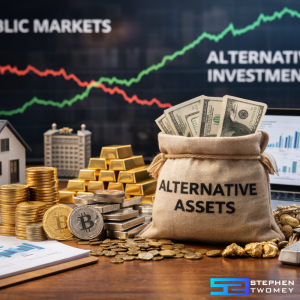

Alternative investments used to be a niche topic for institutions and family offices. Today, they sit in the same conversations as AI, growth strategy, and digital transformation for many business leaders and entrepreneurs.
This guide explains what is considered an alternative investment, how the main categories work, and how modern investors use them alongside traditional portfolios.
Disclosure: This article is for educational purposes only. Nothing here is financial, legal, tax, or investment advice. You should speak with qualified professionals before making any investment decisions.
What Are Considered Alternative Investments?
A working definition for modern portfolios
In simple terms, alternative investments are any assets outside public stocks, bonds, and cash.
They include private equity, private credit, real estate, hedge funds, commodities, digital assets, and collectibles. Different providers slice the list in different ways, yet the core idea is the same. You leave the liquid public markets and move into less traditional, often less regulated territory.
What counts as an alternative investment in practice is consistent across major education sources. You will see similar lists from large brokerages, fintech platforms, and financial media. That consistency helps investors build a mental model, even if some borderline cases exist.
How institutions and regulators classify “alternatives”
Institutional investors and regulators do not use one single legal label for alternatives. Instead, they group assets by structure and risk.
A pension fund may label private equity, private credit, real estate, infrastructure, and hedge funds as “alternatives,” even though those assets are very different. A retail platform may highlight crypto, commodities, and collectibles as alternatives because they sit outside its core stock and ETF menus.
Regulators such as the SEC focus on who can access certain products and under what disclosure rules. Many private funds are limited to accredited investors or qualified purchasers because their strategies are complex and lightly regulated. That is one reason alternative investments often show up first in the world of high net worth investors and family offices.
Core Categories of Alternative Investments
Private equity and venture capital
Private equity involves investing in companies that are not listed on public stock exchanges. Funds pool capital from investors, buy controlling or significant stakes, then work to improve operations and exit at a higher value.
Within private equity, strategies range from buyouts of mature businesses to growth equity for scaling companies. Venture capital is a subset focused on early-stage and high growth startups. The payoff profile can be powerful, but outcomes are highly skewed. A few winners often drive most of the returns, while many portfolio companies fail.
For entrepreneurs and marketing leaders, private equity and venture funds feel familiar. They are often backing the same types of businesses you build or market. That familiarity can help, but it can also create overconfidence if due diligence is thin.
Private credit and direct lending
Private credit refers to non-bank lending where investors provide loans directly to companies or projects. Structures include direct lending funds, mezzanine debt, distressed credit, and specialty finance vehicles.
Borrowers use private credit when speed, flexibility, or complexity makes bank financing difficult. In return, investors receive higher yields, covenants, and sometimes equity kickers. The trade-off is credit risk, complexity, and illiquidity.
For a business owner, private credit can appear on both sides of your life. Your company may raise capital from a private lender. Your personal portfolio might allocate to a private credit fund to capture income that behaves differently from bond indexes.
Real assets, real estate and infrastructure
Real assets include real estate, infrastructure, and sometimes natural resources. Residential and commercial property, logistics warehouses, data centers, toll roads, and renewable energy projects all fall into this group.
Investors can access real assets through direct property ownership, private real estate funds, REITs, infrastructure funds, and newer tokenized structures. The attraction is clear. Real assets can generate income, respond to inflation, and provide tangible diversification.
The trade-offs are also clear. Transactions are slow, valuation is less transparent, and local market dynamics matter. For digital leaders used to dashboards and real-time metrics, this slower feedback loop can feel uncomfortable.
Hedge funds and liquid alternatives
Hedge funds are pooled investment vehicles that use a wide range of strategies, including long-short equity, global macro, event driven, and relative value. Many are structured as private funds for accredited investors.
In recent years, “liquid alternatives” have appeared in mutual fund and ETF wrappers that target similar strategy profiles with more frequent liquidity. These vehicles try to bring some hedge fund techniques into a more regulated format.
For investors, the appeal is potential returns that do not move in lockstep with equity or bond markets. The challenge is evaluating managers, understanding leverage and derivatives, and navigating high fee structures.
Digital assets and cryptocurrency
Digital assets, especially cryptocurrencies, are now firmly treated as alternative investments in most education content.
Crypto offers a new form of scarce digital property and novel infrastructure such as smart contracts and decentralized finance. It also comes with extreme volatility, evolving regulation, custody risk, and a long history of scams.
Sophisticated investors may allocate a small sleeve to digital assets as a high risk, asymmetric bet or as a macro hedge. Others avoid the space entirely. Either choice is valid if it is consistent with your risk tolerance and financial plan.
Collectibles, art and other niche assets
The alternative universe also includes art, classic cars, wine, rare watches, sports cards, and other collectibles.
These assets can hold or grow value over decades, sometimes with very low correlation to markets. They can also be illiquid, opaque, and dependent on taste cycles. Many investors participate here because they love the underlying objects, not just the returns.
New platforms try to fractionalize or securitize collectibles. That can improve access, yet it also adds layers of complexity and fees. As with any alternative asset, the underlying market, not the wrapper, is what ultimately matters.

Why Investors Use Alternative Investments
Diversification and correlation benefits
The main reason investors look at alternatives is diversification. Many alternatives move differently from broad stock and bond indexes. Real estate and commodities may respond to different drivers than large cap equities. Private equity valuations tend to lag public markets. Hedge funds and market neutral strategies can dampen volatility.
When used carefully, this lower correlation can lower overall portfolio risk for a given return target. For an executive with concentrated company stock, alternatives can help reduce dependence on a single issuer or sector.
Illiquidity premium and potential return profile
Alternative investments often ask investors to lock up capital for years. In return, they may offer a higher expected return, sometimes called an illiquidity premium. Private equity, private credit, and certain real estate strategies target this dynamic by holding positions that public markets cannot easily replicate.
The premium is not guaranteed. It depends on manager skill, deal quality, and market conditions. Yet at a portfolio level, institutions have long used alternatives as one of the few levers left when bond yields are low and equity valuations are rich.
Inflation hedging and real value preservation
Real assets such as property, infrastructure, and commodities can respond more directly to inflation. Rents can be reset. Tolls can rise. Physical goods often reflect higher input costs in their prices.
For investors who think in real terms, not nominal returns, these characteristics matter. A portfolio that includes assets with explicit or implicit inflation links can preserve purchasing power when cash and bonds struggle.
How Modern Investors Access Alternative Investments
Institutional investors, family offices and OCIOs
Pensions, endowments, and large family offices have used alternatives for decades. They often work with consultants and OCIOs (outsourced chief investment officers) who run full manager selection and portfolio construction programs.
These institutions may allocate 20 to 50 percent of assets to alternatives, spread across private equity, real estate, hedge funds, and real assets. Their long time horizons and stable capital bases make them well suited to illiquid strategies.
Entrepreneurs who sell businesses or accumulate significant wealth often adopt similar frameworks in a family office structure. They think in terms of total balance sheet rather than isolated trading accounts.
Platforms, private placements and fintech-enabled access
For individual investors, access has widened. There are now:
- Online platforms offering curated private equity, credit, and real estate funds.
- Interval funds and tender-offer funds that hold private assets while offering periodic liquidity.
- Tokenization pilots that fractionalize private or real assets into digital units.
Each route comes with unique risks and operational details. Sourcing deals through platforms requires due diligence on both the platform and the underlying manager. Reading the private placement memorandum is necessary, not optional.
For readers who want to explore the technology side of access, see our guide to digital alternative investment platforms at /alternative-investment-apps.
Practical allocation ranges and portfolio role
Most financial planners suggest modest allocation ranges for individuals. Numbers around 10 to 30 percent of investable assets are common, with the exact level shaped by wealth, time horizon, and risk tolerance. Institutions that allocate more have buffers and governance that many individuals lack.
For a business owner or senior marketer, it can be useful to think in layers. Public stocks, bonds, and cash form the liquid core. Alternatives sit in a satellite role. They target specific goals such as income, inflation protection, or higher long term growth, while acknowledging that capital is tied up.
Are Alternative Investments Right for You?
Alternative investments are not magic. They are tools. They can improve diversification, create new sources of return, and hedge specific risks. They can also tie up capital, layer on fees, and add complexity that does not pay off.
For entrepreneurs, executives, and marketing leaders, the key is context. You already live with concentrated risk in your career, business, or stock compensation. Alternatives can either reinforce that concentration or offset it, depending on how you use them.
A simple way to think about the core question is this:
If a given alternative investment goes to zero or is locked up longer than expected, will it damage my life plans or simply slow my progress?
If the honest answer is “damage,” the position is likely too large or too aggressive.
Again, nothing here is financial advice. The right decision depends on your specific goals, constraints, and risk tolerance. A qualified advisor who understands both traditional portfolios and modern alternatives can help you connect the dots.
For perspectives at the intersection of entrepreneurship, capital allocation, and long-term business value creation, visit StephenTwomey.com.