
None of the content on this site is financial advice.
Brokerage fees matter for every investor. Many traders and allocators ask whether they can reduce taxes by deducting those fees. The answer depends on how the law treats investment expenses and cost basis reporting.
How Brokerage Fees Are Treated for Tax Purposes
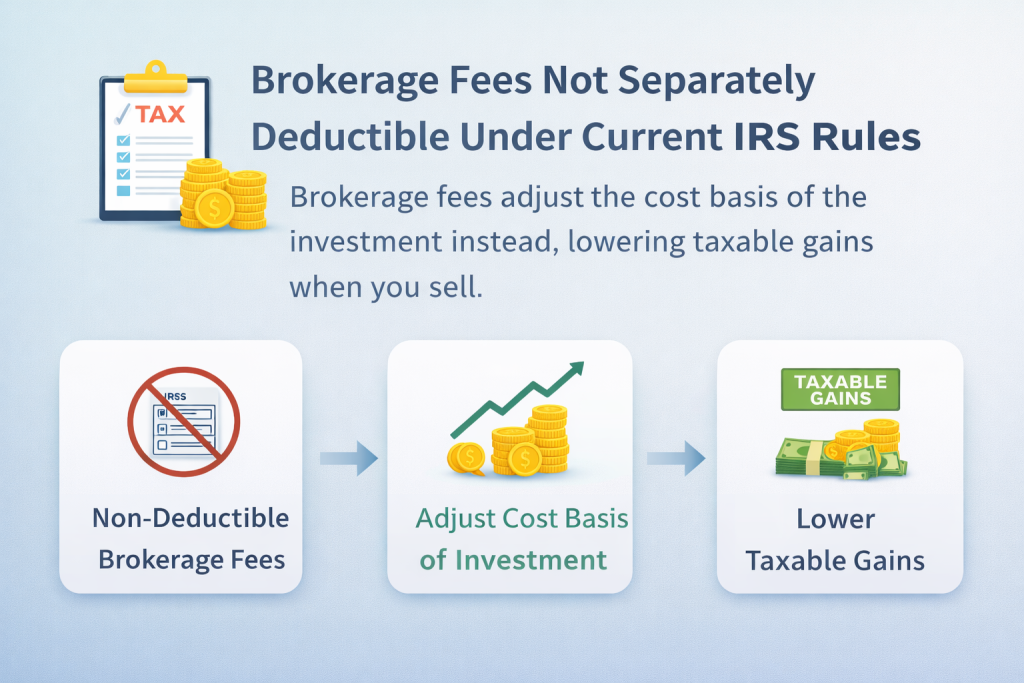
Brokerage fees are the costs charged for trading and account services. They include commissions, transaction fees and some account maintenance charges. Under current IRS rules, most brokerage fees are not separately deductible on individual tax returns. Instead these fees generally adjust the cost basis of the investment which can reduce taxable gains when you sell.
Investment expenses historically fell under Internal Revenue Code Section 212. That code section allowed deduction of ordinary and necessary expenses for producing income. However, changes in tax law changed how these work.
Can You Deduct Brokerage Fees as an Individual Investor?
For most individual investors, the short answer is no. Brokerage commissions and transaction charges are not deductible expenses in the years 2018 through at least 2025. These costs are typically folded into the adjusted cost basis of the investment. When you sell the asset, your taxable gain or loss reflects that adjusted basis.
In practical terms the commission you pay when you buy shares increases your cost basis. When you sell, any commission you pay reduces the proceeds. The result is a net gain or loss that already reflects fees.
What Fees Might Still Have Tax Value
There is one category that still matters for tax planning. Investment interest expense is the interest paid on money borrowed to purchase taxable investments. Under IRS rules, that interest may be deductible up to your net investment income. This deduction is separate from brokerage fees and can help offset taxes.
To claim this expense, you generally need to itemize on Schedule A and complete IRS Form 4952. This is not the same as deducting brokerage fees directly.
Business, Trader, or Trust Situations
Different rules can apply if you qualify as a professional trader or if the account is a business entity or trust. Some traders who treat activity as a business may be able to deduct certain expenses. Entities like irrevocable trusts could have special deductibility rules under IRS guidance. These scenarios require careful compliance and professional tax advice.
Strategies for Tax Efficiency
Tax loss harvesting remains a powerful tool. When you sell investments at a loss, you can use those losses to offset gains and up to $3,000 of ordinary income. Adjusting cost basis accurately and timing trades can reduce overall tax liability.
Tracking cost basis is essential. Use detailed records and brokerage statements that show how commissions affect basis. This ensures your gain or loss reporting is correct and prevents under or over-reporting on tax forms.
Common Misconceptions Accredited Investors Should Know About
Brokerage fees are a routine cost for accredited investors, especially those active in public markets, private placements, or alternative strategies. Despite this, confusion remains about how these fees are treated under current U.S. tax law. Changes introduced by the Tax Cuts and Jobs Act continue to affect deductions in 2025, and many assumptions no longer hold. Understanding these misconceptions helps investors avoid reporting errors and make better tax planning decisions.
Misconception 1: Brokerage fees are still deductible as investment expenses
Many investors believe brokerage fees can still be deducted as miscellaneous itemized deductions. This was true prior to 2018, but current law suspends those deductions through at least 2025. For most individuals, brokerage commissions and advisory fees no longer reduce taxable income directly. Instead, they are handled through cost basis or ignored entirely for deduction purposes, depending on the fee type.
Misconception 2: High income or accredited status changes deductibility
Accredited investor status does not create special tax deductions. Whether an investor meets income or net worth thresholds has no impact on the deductibility of brokerage fees. The IRS applies the same rules regardless of wealth level. Higher income may increase scrutiny or complexity, but it does not restore deductions eliminated by statute.
Misconception 3: Brokerage fees reduce taxes even if not itemized
Some investors assume fees automatically lower taxes even if they do not appear as deductions. While brokerage commissions can affect capital gains through cost basis adjustments, this is not the same as a deduction. Fees paid to buy securities increase basis, and fees paid to sell reduce proceeds. This only impacts taxes when an asset is sold, not annual taxable income.
Misconception 4: Fees in retirement accounts are deductible somewhere
Fees paid inside IRAs, Roth IRAs, or 401(k) plans do not generate tax deductions. These accounts already receive favorable tax treatment through deferral or tax free growth. Attempting to deduct internal account fees is a common error and can trigger compliance issues if reported incorrectly.
Misconception 5: All investment related costs are treated the same
Not all investment costs follow the same tax rules. Brokerage fees, advisory fees, and investment interest expense are often confused. While brokerage fees are generally not deductible, investment interest expense may still be deductible within limits if properly reported. Lumping all costs together leads to missed opportunities or improper filings.
Accredited investors often face more complex portfolios, which makes clarity even more important. Knowing how brokerage fees are actually treated in 2025 allows for cleaner reporting and more effective tax strategy decisions.
Conclusion
Brokerage fees are not separately tax deductible for most individual investors in 2025. Instead these fees generally adjust cost basis. Investment interest expense may still be deductible within limitations. Tracking fees, cost basis, gains and losses is vital to tax-efficient investing.
For more insights on business development, capital growth strategies, and the evolving landscape of private markets, visit StephenTwomey.com — where strategy meets execution.