
The alternative investment industry has become a central focus for sophisticated investors seeking diversification, return enhancement and access to private markets. In a low-yield, volatile environment traditional stocks and bonds no longer suffice. Accredited investors, family offices and institutional allocators are turning to alternative assets with focus and intent.
Introduction to the Alternative Investment Industry
The term “alternative investment industry” refers to the market for asset classes beyond conventional stocks, bonds and cash. Once reserved for institutional investors, this industry now spans private equity, private credit, real assets, hedge funds and emerging digital vehicles.
As portfolios evolve under depreciation of yields and rising volatility, understanding the size, structure and strategic implications of this industry becomes essential for accredited investors.
Market Size, Growth & Institutional Dynamics
Industry data show that alternatives-AUM has expanded rapidly. For example, one report projects global alternatives could reach $29.2 trillion by 2029 from about $16.8 trillion at end-2023. Institutional allocators are increasing commitments accordingly. A recent survey found allocations to alternative assets by pension funds, sovereign wealth funds and endowments have moved into the 20 %-30 % range.
These shifts reflect a search for enhanced return and diversification in a low-yield environment. The scale of capital deployment now supports dedicated secondaries, co-investment programmes and continuation vehicles as mainstream elements of the industry.
Key Asset Classes Within the Industry
The alternative investment industry covers a wide set of strategies that operate outside traditional public markets. These asset classes often move differently than stocks and bonds which creates opportunities for return enhancement and risk diversification. Accredited investors and institutions use these segments to capture inefficiencies, pursue long horizon themes and access private market growth.
Private equity and venture capital
Private equity focuses on acquiring and improving companies that are not publicly traded. Investors commit capital to managers who identify businesses with strong fundamentals and clear operational levers. Returns often come from revenue growth, cost improvements or strategic repositioning. This part of the market rewards patience and strong governance because the holding period tends to be longer than public equities.
Venture capital sits within the same broader category but targets early stage companies. These firms build new technologies, services or platforms that can scale quickly. Risk is higher because many ventures do not reach maturity. However the return potential can be strong when a company creates a valuable market position. Accredited investors use this category to gain exposure to innovation cycles that do not appear in public markets.
Private credit and debt strategies
Private credit provides lending solutions to companies that want capital without going through traditional banks. Direct lending, special situations and opportunistic credit are common structures. Investors receive interest payments which can be appealing in a higher rate environment. This segment also gives managers flexibility to negotiate terms and covenants that protect capital.
Debt strategies in private markets can address complex scenarios such as restructurings or growth capital for middle market firms. The risk profile shifts with deal quality, collateral and underwriting discipline. Investors who value steady income often use private credit because it seeks predictable cash flow. Although performance depends on manager skill, the sector can complement equity heavy portfolios.
Real assets, infrastructure and real estate
Real assets include physical or tangible properties such as buildings, land and infrastructure systems. These investments often produce stable long term cash flows. For example, leased commercial property or contracted infrastructure projects can generate recurring income. Investors also value real assets for their potential to hedge inflation because physical assets may retain value in shifting economic cycles.
Infrastructure and real estate form core pillars within this category. Infrastructure covers assets like roads, utilities and renewable energy which support essential economic activity. Real estate spans residential, industrial and commercial segments. Both areas attract investors seeking steady yield and long duration exposure. These strategies often rely on careful underwriting, location quality and consistent operational management.
Hedge funds, liquid alternatives and emerging digital assets
Hedge funds use varied strategies to generate returns in different market conditions. These may include long short equity, macro trading or relative value approaches. Managers aim to find inefficiencies or dislocations that traditional investors may overlook. This flexibility can help portfolios when markets become volatile. The level of risk varies with each strategy so due diligence is critical.
Liquid alternatives offer access to hedge fund like strategies in vehicles that allow more frequent liquidity. These can fit into portfolios that need flexibility. Emerging digital assets are also becoming part of the broader landscape. Tokenised real assets, blockchain based funds and digital infrastructure plays are attracting attention from investors who want exposure to structural technological shifts. This area is evolving quickly so understanding regulation, custody and platform risk remains important.

Access, Distribution and Retailization
Historically access to the alternative investment industry was confined to institutions and ultra-high-net-worth investors. Today platforms and private placement vehicles are opening channels for accredited investors and family offices to participate in private markets.
Tokenisation, fintech vehicles and fund structures with expanded liquidity terms are enabling broader access. This shift means the alternative investment industry is no longer strictly closed-door.
Internal Link: See our article on private-capital insights for a deeper look at vehicles and structures.
Performance, Risk, Fees and Structural Headwinds
The alternative investment industry faces a paradox. On one hand capital is growing rapidly. On the other hand performance across some asset classes is under pressure. For example, a recent commentary notes that despite growth in assets under management, returns have disappointed in several sectors.
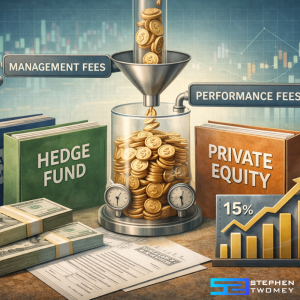
Key structural issues include illiquidity, high fee structures, complexity and transparency. These factors remain fault-lines in the industry. Governance of GP/LP structures, alignment of interest, exit-mechanisms and valuation practices require rigorous oversight. Fees (including carry and management fees) still compress net returns in many cases.
Another risk is liquidity mismatch. Some alternative assets have long lock-up periods while investors may expect flexibility. Regulatory scrutiny, tax complexity and operational burdens (data, reporting, technology) also weigh on managers and investors alike.
Strategic Implications for Accredited Investors
For accredited investors the alternative investment industry offers meaningful strategic potential but demands discipline.
Diversification and complementarity: Alternatives often bring different risk-return and correlation profiles relative to stocks and bonds. When sized appropriately they can enhance portfolios.
Due diligence and manager selection: Evaluating GPs, fee models, co-investment access, secondaries capabilities and governance remains critical.
Trend positioning: Investors should consider how macro themes such as AI, ESG, infrastructure transition and digital assets play into alternative strategies. For example, those managers who integrate data analytics, technological platforms and scale advantages may generate a competitive edge.
Liquidity planning: Match investment horizon and liquidity terms. Recognise that within the alternative investment industry not all assets are created equal in terms of entry, exit, cost or governance.
The Future of the Alternative Investment Industry
Looking ahead the alternative investment industry is set to expand. Key studies forecast double-digit growth in AUM by 2030 as more capital seeks private market exposure.
Innovation is playing a major role: data platforms, secondary market infrastructure, tokenised assets, digital distribution and AI for deal sourcing and portfolio management all inform the future-state of the industry.
For private clients and family offices this means the alternative investment industry will increasingly resemble mainstream opportunity rather than exotic sidelining. The challenge for investors: stay ahead of the structural shift, maintain governance, access quality managers and recognise the difference between being part of the growth and being subject to crowding.
Conclusion & Actionable Takeaways
The alternative investment industry has matured from niche to mainstream. For accredited investors it offers opportunity but also demands discipline.
Three-point action plan:
- Align allocation to alternative assets with strategy, time-horizon and liquidity profile.
- Conduct rigorous due diligence: review fees, governance, transparency and exit mechanisms.
- Stay informed about technology, distribution innovation and thematic shifts (ESG, infrastructure, digital assets).
- This is not financial advice. Investors should consult professionals before making investment decisions.
For more insights on business development, capital growth strategies, and the evolving landscape of private markets, visit StephenTwomey.com — where strategy meets execution.