

Are 401K contributions tax deductible is a common question for investors planning retirement. How contributions affect taxable income matters for both wealth strategy and tax efficiency.
What is a 401(k) and How Contributions Work
A 401(k) is an employer-sponsored retirement plan that allows participants to defer a portion of their compensation into a tax-advantaged investment account. Contributions are typically made through payroll deductions, which means the funds are invested before the employee receives their net pay.
For accredited investors, the 401(k) often serves as a foundational layer within a broader wealth strategy rather than the sole retirement vehicle. Traditional 401(k) contributions are made with pre-tax dollars, reducing current taxable income, while Roth 401(k) contributions are funded with after-tax dollars in exchange for potential tax-free withdrawals later. Assets inside the plan grow on a tax-deferred basis, allowing compounding to occur without annual tax drag.
Most plans offer a menu of mutual funds, index funds, and target-date funds, though some high-income professionals also gain access to self-directed brokerage windows.
Employer matching contributions further enhance the plan’s value, effectively creating a guaranteed return on a portion of the employee’s savings. For accredited investors accustomed to evaluating risk, return, and liquidity, understanding the mechanics of the 401(k) is essential before layering in alternative or private investments.
Contributions to a 401(k) are governed by annual limits set by the IRS, with higher thresholds available for individuals over age 50 through catch-up contributions. Employees elect a contribution percentage or dollar amount, which is automatically deducted from each paycheck and allocated according to their chosen investment mix.
From a planning perspective, accredited investors often view these contributions as a way to manage taxable income, smooth cash flow, and build a pool of long-term capital that complements other holdings.
Employer contributions, such as matching or profit-sharing, are subject to vesting schedules and plan rules, but they can materially increase total retirement savings over time. It is also important to understand liquidity constraints. Withdrawals before age 59½ may trigger taxes and penalties, making the 401(k) a long-term vehicle rather than a flexible capital source.
For sophisticated investors, the key is integration. A 401(k) should align with broader goals that may include private placements, real assets, and tax-efficient structures. When used strategically, it provides stability and tax efficiency within a diversified wealth framework.
Are 401(k) Contributions Tax Deductible?
401(k) contributions are often described as tax deductible, but the technical treatment is more precise. Traditional 401(k) contributions reduce taxable income at the time they are made, which lowers current year federal income tax liability. This reduction happens before income is reported on a tax return, rather than as a line item deduction claimed later. In practice, the outcome is similar to a deduction because adjusted gross income is lower.
This structure is especially relevant for accredited investors operating in higher marginal tax brackets, where income deferral can materially impact cash flow and effective tax rates. However, the tax benefit is temporary rather than permanent. Taxes are deferred until withdrawals occur in retirement, at which point distributions are generally taxed as ordinary income.
This distinction matters when evaluating future tax exposure, especially for investors who expect to maintain significant income streams later in life. Understanding that a 401(k) offers tax deferral rather than tax elimination is critical when modeling long term outcomes and comparing retirement vehicles.
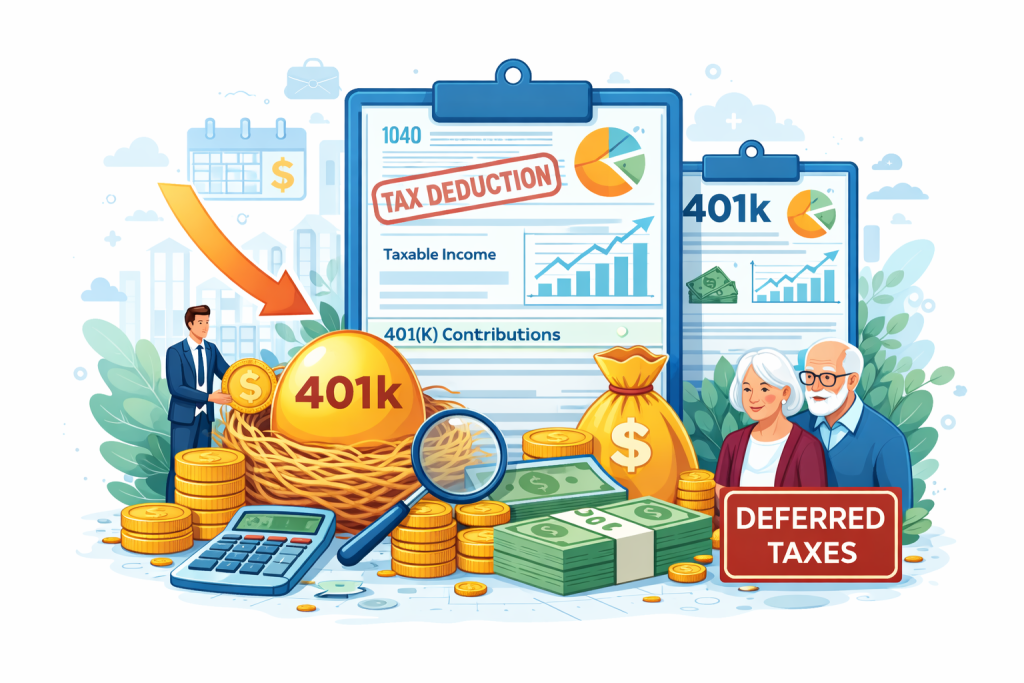
Traditional 401(k) vs Roth 401(k) Tax Treatment
The difference between a traditional 401(k) and a Roth 401(k) centers on timing. Traditional contributions are made with pre tax dollars and reduce taxable income today, while Roth contributions are made with after tax dollars and do not provide an immediate tax benefit.
In exchange, qualified Roth withdrawals in retirement are generally tax free. For accredited investors, the decision is less about which option is better and more about which aligns with projected future tax conditions. If future tax rates are expected to be higher, Roth contributions can provide long term protection against tax increases.
If current income is unusually high, traditional contributions may offer immediate relief at higher marginal rates. Some employer plans allow participants to split contributions between both types, creating tax diversification across time. This flexibility can be valuable for investors managing business income, equity compensation, or variable cash flows. The strategic choice often depends on career stage, anticipated exit events, estate considerations, and how retirement assets complement other tax structured investments.
How 401(k) Contributions Affect Your Taxable Income
Traditional 401(k) contributions lower taxable income by reducing the amount of wages subject to federal income tax. This reduction can have secondary effects beyond simple tax savings. Lower taxable income may influence eligibility for certain credits, deductions, or phaseouts, although many of these benefits are less relevant at higher income levels.
For accredited investors, the primary impact is often the ability to defer taxation on income that would otherwise be exposed to top marginal rates. This can improve short term liquidity and allow capital to remain invested longer.
However, it is important to recognize that deferred income is not excluded from taxation permanently. Required minimum distributions in later years can push retirees into higher tax brackets if balances grow significantly.
This dynamic underscores the importance of coordinating 401(k) contributions with withdrawal strategies, Roth conversions, and taxable account management. Viewed correctly, the 401(k) is a timing tool for income recognition rather than a simple tax shelter.
Employer Contributions and Tax Deductions
Employer contributions, commonly in the form of matching or profit sharing, add another layer to the 401(k) tax equation. From the employee perspective, these contributions are not treated as taxable income when made. They grow tax deferred inside the plan and are taxed only upon withdrawal. For employers, contributions are generally deductible as a business expense, subject to IRS limits and plan rules. For accredited investors who are business owners or partners, this dual treatment can be particularly powerful.
Employer contributions effectively allow income to move from the business balance sheet into a tax deferred personal asset while reducing current business taxes. Vesting schedules may apply, which determine when the employee gains full ownership of employer funds.
Understanding these rules is essential when evaluating total compensation and long term value. Employer contributions should not be viewed as free money alone, but as a structured component of compensation and tax planning that interacts with broader wealth and succession strategies.
Solo 401(k) and Self-Employed Deduction Rules
Self-employed investors with a Solo 401(k) can make both employee and employer contributions. The employee portion reduces personal taxable income, while the employer portion is deductible as a business expense under IRS business rules.
Strategic Tax Planning With 401(k) Contributions
Consider splitting contributions between traditional and Roth accounts to balance present-day tax benefits with future tax flexibility. Also evaluate whether you qualify for credits such as the Saver’s Credit. Align your contribution strategy with anticipated retirement tax rates.
Common Questions
Do 401(k) Contributions Reduce Federal Tax?
Traditional 401(k) contributions reduce federal taxable income in the year the contribution is made. This happens automatically because the contribution is excluded from gross wages reported on your W-2. For example, if an employee earns $120,000 and contributes $20,000 to a traditional 401(k), federal income tax is calculated on $100,000 instead of the full salary.
This reduction can lower the total tax owed and, in some cases, move the taxpayer into a lower marginal tax bracket. It is important to note that this tax benefit applies only to traditional 401(k) contributions. Roth 401(k) contributions do not reduce federal tax in the current year because they are made with after tax dollars.
However, Roth contributions may provide tax advantages later, since qualified withdrawals are generally tax free. Employer matching contributions do not count as taxable income when contributed, but they will be taxed when withdrawn in retirement. The key distinction is that a 401(k) does not create a separate deduction on a tax return, it reduces taxable income at the source through payroll deferral.
Does Contributing to a 401(k) Affect State Taxes and Are There Limits on Contributions?
In most states, traditional 401(k) contributions reduce state taxable income in the same way they reduce federal taxable income. States that conform to federal tax rules typically exclude pre tax 401(k) contributions from wages when calculating state income tax. However, state tax treatment is not uniform across the country. A small number of states have unique rules or do not offer the same tax deferral benefits, so taxpayers should review their specific state regulations. Contribution limits are set annually by the IRS and apply nationwide.
These limits cap how much an employee can defer into a 401(k) each year, with higher catch up limits available for individuals age 50 and older. Employer contributions are subject to separate overall plan limits. Exceeding contribution limits can lead to penalties and corrective distributions, which may create unexpected tax consequences.
Understanding both state tax treatment and contribution limits is essential for effective retirement planning and for avoiding compliance issues that could reduce the long term benefits of a 401(k).
Conclusion
Traditional 401(k) contributions effectively reduce taxable income in the year you make them, while Roth contributions offer future tax-free growth. Align tax strategy with your broader retirement plan and income expectations.
For perspectives at the intersection of entrepreneurship, capital allocation, and long-term business value creation, visit StephenTwomey.com.
Disclosure: None of the writing on this article or site is financial advice.