
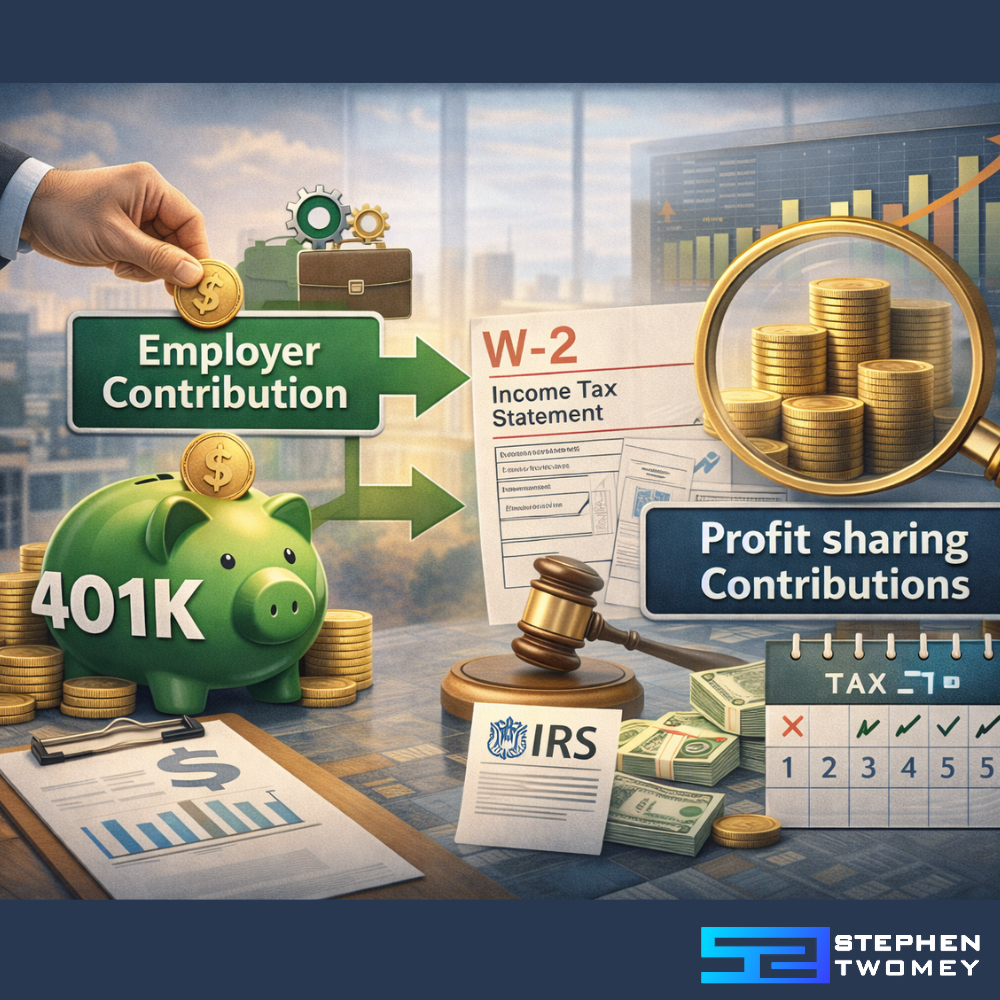
Employer contributions to your 401(k) plan are a valuable part of retirement compensation. Understanding how they are taxed helps you plan income and taxes for retirement.
Retirement savings strategies hinge on knowing when and how income is taxed. Employer 401(k) contributions have specific rules that differ from employee deferrals.
How Employer Contributions Work in a 401(k) Plan
A 401(k) is a qualified retirement plan governed by IRS rules. Employers can make contributions in two main forms.
Matching contributions reward you for deferring your own income. For example, an employer might match 50 cents on the dollar up to a set percent of your salary.
Profit-sharing contributions are discretionary. The employer decides each year whether to allocate a share of profits to employee accounts.
Employer contributions may vest over time. Vesting is the schedule that determines when you own the contributions fully.
Tax Treatment of Employer 401(k) Contributions
Employer contributions to a 401(k) plan are generally not taxed at the time they are made, which is one of their primary advantages for high income earners and accredited investors. When an employer provides a matching contribution or a profit sharing contribution, that amount is deposited directly into the employee’s qualified retirement account. It does not appear as taxable wages on the employee’s Form W-2 and does not increase current year federal income tax liability.
From an IRS perspective, these contributions are considered part of a qualified deferred compensation structure, not earned income in the year of contribution. This treatment allows investors to benefit from additional retirement capital without triggering immediate taxation. For accredited investors who already face higher marginal tax rates, this deferral can materially improve after tax cash flow and long term compounding.
It is important to note that while employer contributions are excluded from income taxes when made, they are still subject to plan rules such as vesting schedules and annual contribution limits. The lack of immediate taxation does not eliminate tax exposure, it simply shifts it to a later stage of the investment lifecycle.
Tax Deferral Explained
Tax deferral is the core concept that governs how employer 401(k) contributions are treated. When funds are contributed on a pre tax basis, both the principal and any subsequent investment gains grow without current taxation. This allows the account balance to compound more efficiently over time compared to taxable investment accounts.
For accredited investors with long time horizons, tax deferral can significantly enhance total returns, especially when paired with disciplined asset allocation inside the plan. Employer contributions follow this same framework.
The IRS permits deferral because the funds are restricted for retirement use and governed by qualified plan rules. Unlike taxable income, deferred contributions are not subject to annual tax drag from dividends, interest, or capital gains. However, tax deferral is not tax elimination. The government is effectively allowing you to postpone taxation in exchange for limiting access to the capital until retirement age.
This tradeoff can be advantageous when future tax rates are expected to be lower, or when the investor values liquidity outside the plan for alternative investments, private placements, or other accredited investor strategies.
When Taxes Are Paid
Taxes on employer 401(k) contributions are generally paid when distributions are taken from the plan. At that point, withdrawals are treated as ordinary income and taxed at the investor’s prevailing marginal tax rate. This applies to both the original employer contributions and all accumulated investment gains.
For most investors, distributions begin in retirement, when earned income is lower and tax brackets may be more favorable. However, early withdrawals taken before age 59½ typically trigger both income tax and an additional early distribution penalty, unless a specific IRS exception applies. Required minimum distributions also come into play once the investor reaches the applicable age, forcing taxable withdrawals even if the capital is not needed.
For accredited investors, understanding this timing is essential for broader wealth and tax planning. Employer contributions can be a powerful tool when coordinated with Roth strategies, alternative assets held outside retirement accounts, and long term estate planning objectives. Proper planning focuses not just on deferring taxes, but on controlling when and how those taxes are ultimately recognized.
How Employer 401(k) Contributions Affect Your Income Taxes
Employer 401(k) contributions play a meaningful role in how accredited investors manage current income taxes while positioning long term capital. From an income tax standpoint, employer contributions are not included in taxable wages in the year they are made. This means they do not increase adjusted gross income, do not affect marginal tax brackets, and do not trigger additional federal income tax liability in the contribution year.
For high earners, this structure provides a form of indirect tax efficiency. Compensation is enhanced without increasing current tax exposure. Employer matching and profit sharing contributions also grow tax deferred inside the plan, allowing capital to compound without annual tax drag.
Over time, this deferral can materially improve after tax outcomes, especially for investors already facing phaseouts on deductions and credits. While these contributions do not reduce taxable income in the same way employee deferrals do, they preserve tax efficiency by delaying recognition until retirement, when income levels may be lower or more controllable.
For accredited investors with complex income streams, employer 401(k) contributions also affect broader tax planning strategies. Because these contributions are excluded from current taxable income, they do not interfere with eligibility thresholds tied to adjusted gross income, such as Medicare surtaxes or certain investment related limitations.
This separation allows investors to pursue higher active income while still benefiting from retirement plan tax deferral. However, taxes are not eliminated. They are deferred. Withdrawals in retirement are generally taxed as ordinary income, which makes long term planning essential. Coordinating future distributions with other income sources such as private investments, real estate cash flow, or required minimum distributions becomes critical.
Many high net worth investors use this understanding to align retirement account withdrawals with years of lower taxable income or strategic Roth conversions. In this context, employer 401(k) contributions are less about short term tax savings and more about long range tax control and flexibility.
Traditional vs Roth 401(k) Contributions and Employer Match
Employee contributions to a traditional 401(k) are pre-tax and lower taxable income. In a Roth 401(k), employee contributions are after tax.
Employer match in Roth plans
Even if your contributions are Roth, the employer match goes into a traditional, pre-tax portion of the plan. That employer match is still tax deferred and taxed upon withdrawal.
This difference matters for retirement tax planning. Roth contributions grow tax-free but the employer portion does not.
Payroll Taxes and Other Tax Considerations
Employer 401(k) contributions are generally exempt from Social Security and Medicare payroll taxes. They are also deductible for the employer within IRS limits, often up to 25 percent of covered payroll.
This creates tax benefit symmetry. The employer gets a deduction and the employee gains deferred taxation until retirement.
Employer Tax Benefits for 401(k) Contributions
From the company perspective, contributions are deductible business expenses. Employers claim deductions within limits defined by IRS code section 404. These rules include timing and allocation requirements.
Proper plan operation ensures the tax benefits remain valid. Missteps can lead to penalties or loss of qualification.
Common Questions on 401(k) Employer Contribution Taxation
Are Employer Contributions Reported on Form W-2?
They are not included in taxable wages on your W-2. They may be reported in box 12 with code D to indicate contributions but not taxed that year.
Does Employer Match Count Toward Your Contribution Limit?
Employer match does not count against your individual contribution limit. However, there is a combined total limit for all contributions.
What Happens if You Withdraw Employer Contributions Early?
Withdrawals before 59½ trigger income tax and possibly a 10 percent penalty, unless an exception applies.
None of the content here is financial advice. Consult a tax professional for your situation.
Explore more insights on scaling businesses, building strategic partnerships, and navigating modern investment ecosystems at StephenTwomey.com.