

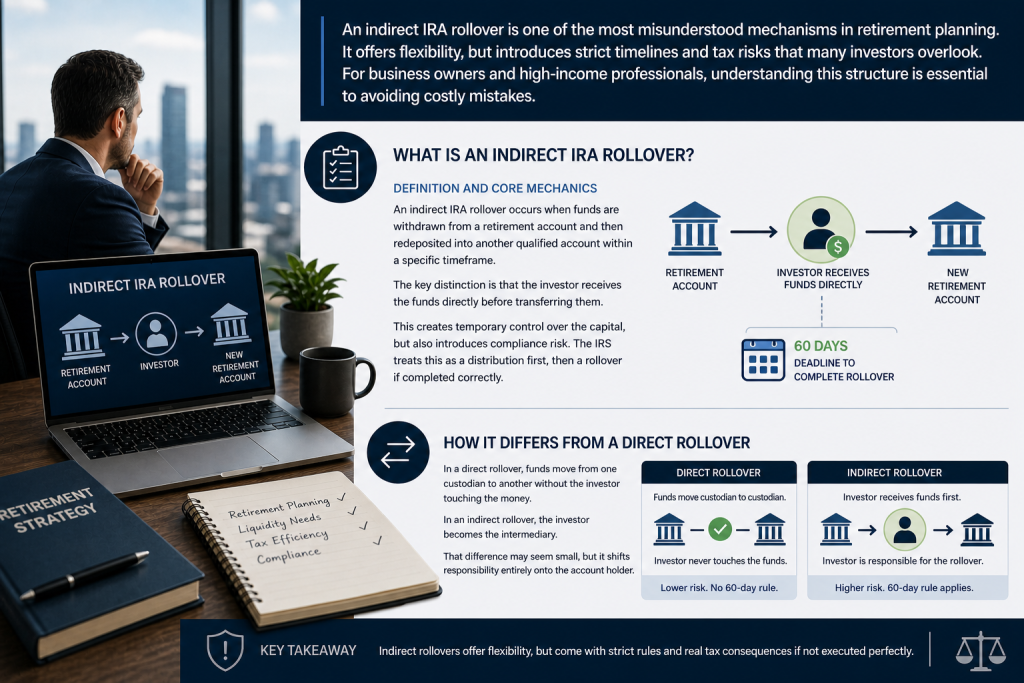
An indirect IRA rollover is one of the most misunderstood mechanisms in retirement planning. It offers flexibility, but introduces strict timelines and tax risks that many investors overlook. For business owners and high-income professionals, understanding this structure is essential to avoiding costly mistakes.
What is an Indirect IRA Rollover?
Definition and Core Mechanics
An indirect IRA rollover occurs when funds are withdrawn from a retirement account and then redeposited into another qualified account within a specific timeframe. The key distinction is that the investor receives the funds directly before transferring them.
This creates temporary control over the capital, but also introduces compliance risk. The IRS treats this as a distribution first, then a rollover if completed correctly.
How It Differs From a Direct Rollover
In a direct rollover, funds move from one custodian to another without the investor touching the money. In an indirect rollover, the investor becomes the intermediary.
That difference may seem small, but it shifts responsibility entirely onto the account holder.
How the Indirect IRA Rollover Process Works
An indirect IRA rollover introduces more moving parts than most retirement transfers. Unlike a direct rollover, the responsibility shifts to the investor to manage timing, cash flow, and compliance. That combination creates both flexibility and risk, especially for business owners or investors managing multiple financial priorities at once.
Step-by-Step Breakdown
An indirect IRA rollover follows a structured but sensitive sequence. First, the retirement account custodian distributes funds directly to the account holder. This distribution may come from an IRA or an employer-sponsored plan like a 401(k). In many cases, especially with employer plans, 20 percent is withheld for federal taxes before the funds are released.
Once the investor receives the funds, the responsibility shifts entirely to them. The next step is to deposit the full original amount into another qualified retirement account. This includes replacing any withheld portion using personal funds. For example, if $100,000 is distributed and $20,000 is withheld, the investor must redeposit the full $100,000 to avoid taxation.
After the redeposit is completed, the transaction is treated as a rollover rather than a taxable distribution. However, documentation is critical. Investors should keep records of the distribution date, amount received, and confirmation of redeposit to ensure compliance with IRS requirements.
Timeline and the 60-Day Rule
The 60-day rule is the defining constraint of an indirect IRA rollover. From the moment the investor receives the funds, a strict 60-day clock begins. Within that window, the full amount must be redeposited into a qualified retirement account. There is no margin for delay in most cases.
If the deadline is missed, the IRS treats the distribution as taxable income. For individuals under age 59½, this can also trigger a 10 percent early withdrawal penalty. The financial impact can be significant, especially for large distributions.
While the IRS does allow limited exceptions, such as hardship waivers, these are not guaranteed and often require formal approval. This makes reliance on exceptions a high-risk strategy.
In practice, the 60-day rule demands precision. Investors must plan for timing, liquidity, and administrative processing delays. Even small issues, such as banking transfer lags or custodial processing times, can reduce the effective window and increase the risk of error.
Key IRS Rules and Compliance Requirements for Accredited Investors
The 60-Day Deadline Explained
The 60-day rule is absolute in most cases. Missing it converts the transaction into a taxable distribution.
Limited exceptions exist, but they require IRS approval or qualifying hardship circumstances.
The One-Rollover-Per-Year Rule
Investors can only complete one indirect rollover per 12-month period across all IRAs. This rule often surprises even experienced investors.
Mandatory Withholding Requirements
For employer-sponsored plans, a 20% federal withholding is typically applied. To complete a full rollover, the investor must replace that amount from personal funds.
Taxes and Penalties You Need to Understand
Understanding the tax implications of an indirect IRA rollover is critical before initiating one. While the structure allows temporary access to funds, it also creates multiple points where mistakes can trigger taxes or penalties. The IRS treats these transactions with strict oversight, and even minor missteps can result in unexpected liabilities. For investors and business owners, the risk is not theoretical. It is financial and immediate.
When an Indirect Rollover Becomes Taxable
An indirect IRA rollover becomes taxable when the transaction fails to meet IRS requirements, most commonly the 60-day redeposit rule. If funds are not fully returned to a qualified retirement account within that timeframe, the IRS reclassifies the distribution as ordinary income. This means the entire amount is added to your taxable income for the year, which can push you into a higher tax bracket.
Another trigger occurs when the full distribution amount is not redeposited. For example, if 20 percent is withheld for taxes and not replaced with personal funds, that portion is treated as a taxable distribution. This creates a partial failure, even if the rest of the rollover is completed correctly.
In practice, timing errors and liquidity gaps are the most common causes. Investors often underestimate how quickly the 60-day window closes. Once missed, the tax consequences are automatic unless a rare IRS waiver is granted.
Early Withdrawal Penalties
In addition to income taxes, early withdrawal penalties can apply if the account holder is under age 59½. When an indirect rollover fails, the IRS treats the distribution as a withdrawal, not a transfer. This triggers a 10 percent penalty on top of ordinary income tax, significantly increasing the total cost.
For example, a $100,000 failed rollover could result in $10,000 in penalties alone, excluding income taxes. For high-income earners, the combined impact can exceed 40 percent depending on their tax bracket. This is where a simple administrative error becomes a substantial financial setback.
There are limited exceptions to the penalty, such as certain hardship situations or qualified distributions, but these are narrowly defined. Most failed rollovers do not qualify. This is why indirect rollovers are generally viewed as high-risk unless executed with precision and clear understanding of the rules.
Common Mistakes That Trigger Taxes
Most tax issues related to indirect rollovers come from preventable errors. The most frequent mistake is missing the 60-day deadline, often due to delays in banking, misunderstandings about when the clock starts, or simple oversight. The countdown begins when funds are received, not when they are deposited or transferred.
Another common mistake is failing to redeposit the full amount, including any withheld taxes. Many investors assume the withheld portion is handled separately, but the IRS requires the entire distribution to be returned to maintain tax-deferred status.
Attempting multiple indirect rollovers within a 12-month period is another critical error. The IRS enforces a one-rollover-per-year rule across all IRAs, not per account. Violating this rule can invalidate subsequent rollovers and trigger taxation.
Poor documentation and lack of professional guidance also increase risk. Without clear records and oversight, small discrepancies can lead to audits, penalties, or reclassification of the transaction.
Direct vs. Indirect IRA Rollover
Key Differences
A direct rollover avoids withholding, timing risk, and compliance complexity. An indirect rollover introduces all three.
Risk Comparison
Indirect rollovers carry higher execution risk. Even small administrative errors can lead to significant tax consequences.
When an Indirect Rollover May Be Used Strategically
In rare cases, investors use indirect rollovers for short-term liquidity. This effectively creates a temporary, interest-free loan.
However, this strategy requires precise timing and strong cash flow management.
Strategic Use Cases for Indirect Rollovers
Short-Term Liquidity Scenarios
Some investors use the 60-day window to access capital temporarily. This may support business operations or bridge financing gaps.
Advanced Investor Strategies
High-net-worth individuals may use indirect rollovers in coordination with broader tax planning strategies. These are typically executed with professional oversight.
Risks for Business Owners and Entrepreneurs
Entrepreneurs often underestimate timing risk. Cash flow variability can make it difficult to redeposit funds within 60 days.
Indirect Rollovers in Self-Directed IRAs
Alternative Investments and Timing Risks
Self-directed IRAs often involve private placements or real estate. Timing becomes even more critical when coordinating investment closings.
Compliance Considerations
Custodians for self-directed IRAs may have additional processing timelines. This can reduce the effective window for completing a rollover.
For more on structuring investment strategies, see /wealth-strategies.
Best Practices to Avoid Costly Errors
Documentation and Tracking
Maintain clear records of distribution dates, amounts, and redeposit confirmations. Small errors can trigger audits or penalties.
Working With Custodians and Advisors
Professional oversight reduces risk. Tax advisors and custodians can help ensure compliance with IRS rules.
Risk Mitigation Checklist
- Confirm distribution date immediately
- Track the 60-day deadline precisely
- Replace withheld funds if necessary
- Avoid multiple rollovers in one year
“The 60-day rule is not a guideline. It is a hard deadline with financial consequences.”
Frequently Asked Questions About Indirect IRA Rollovers
Can you miss the 60-day deadline?
Yes. If missed, the distribution becomes taxable. In rare cases, a waiver may be granted by the IRS.
Can you do multiple rollovers?
No. Only one indirect rollover is allowed per 12-month period across all IRAs.
Is withholding refundable?
Yes. If the rollover is completed correctly, withheld taxes may be recovered when filing your tax return.
Final Thoughts on Indirect IRA Rollovers
Indirect IRA rollovers offer flexibility, but they demand precision. For most investors, a direct rollover is the safer and more efficient choice.
For those considering an indirect approach, understanding IRS rules, timing constraints, and tax implications is essential. The margin for error is small, and the consequences can be significant.
This article is for informational purposes only and does not constitute financial advice. Always consult a qualified financial professional before making investment decisions.
Explore more insights on scaling businesses, building strategic partnerships, and navigating modern investment ecosystems at StephenTwomey.com.