
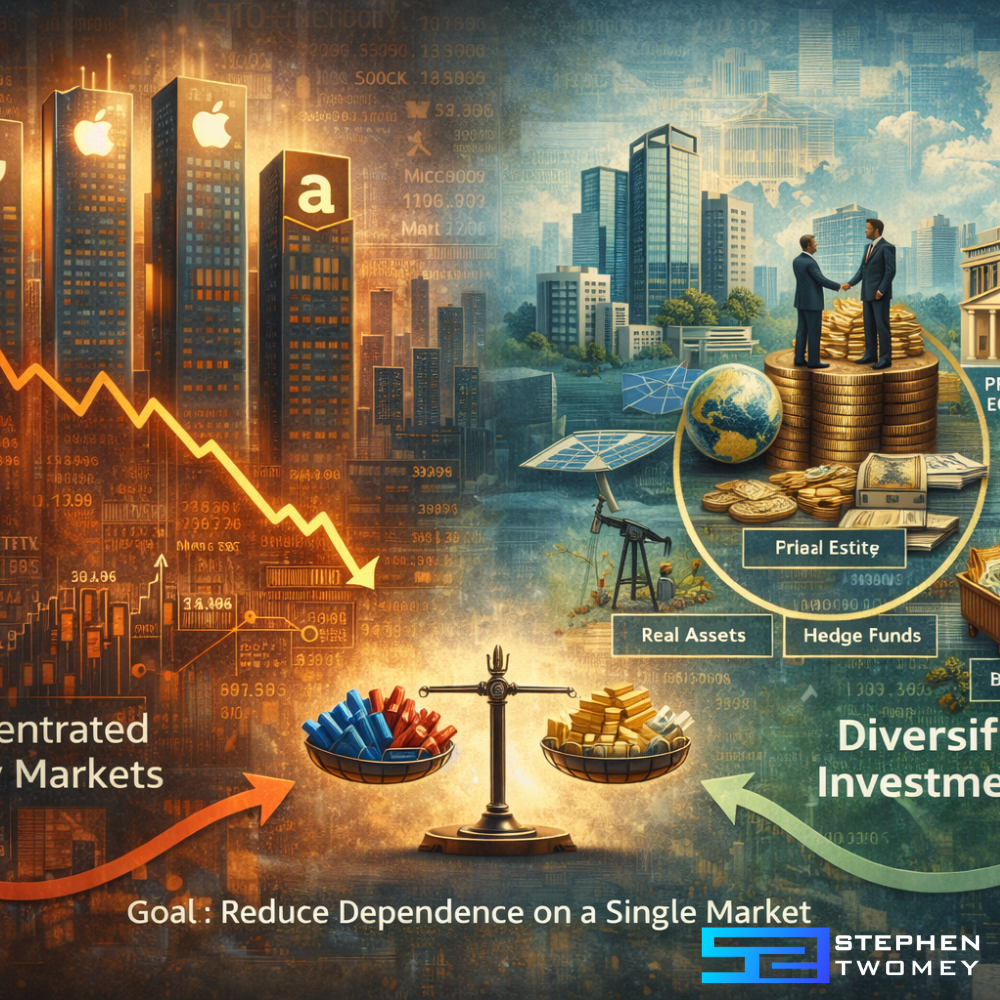
Public equities dominate most portfolios, but they are not the only path to long-term wealth. As markets become more concentrated and volatile, investors increasingly explore other investments besides stocks. These alternatives can offer diversification, income, and exposure to growth drivers unavailable in public markets.
Why Investors Look for Other Investments Besides Stocks
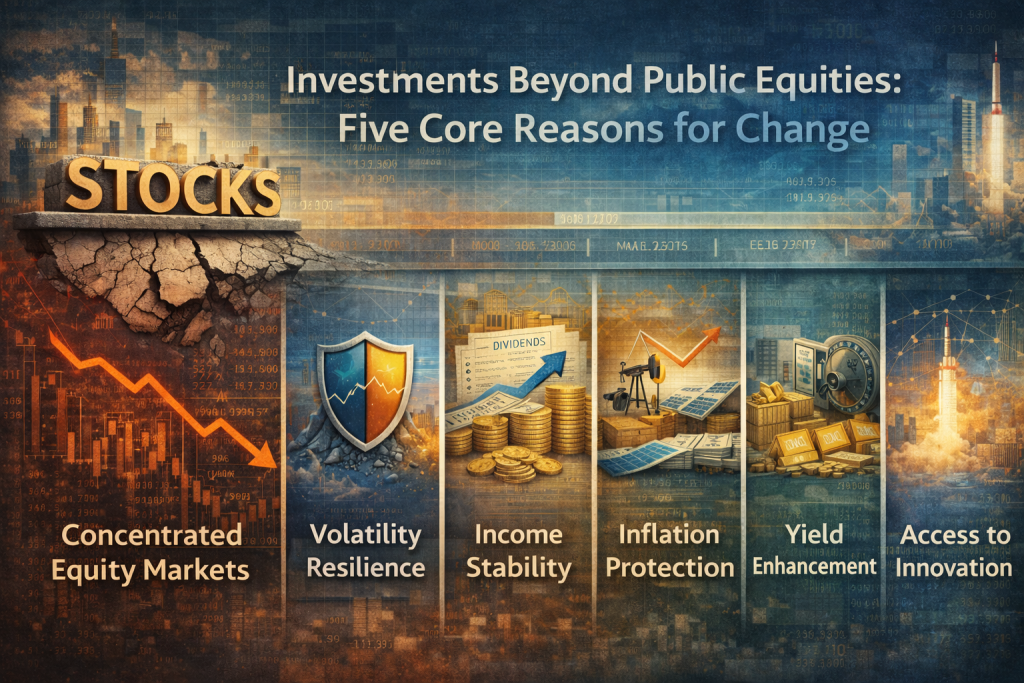
Relying solely on public equities once formed the backbone of long-term investing. That assumption has weakened. Structural changes in markets, policy, and capital formation have pushed investors to rethink how risk and return are generated. Other investments besides stocks are no longer niche options. They are now strategic tools used to improve resilience, income stability, and long-term outcomes. Below are five core reasons driving this shift.
Market Concentration and Correlation Risk
Modern equity markets are increasingly concentrated in a small number of large companies. Major indices derive a disproportionate share of returns from a handful of technology and mega-cap firms. This creates hidden risk, even in portfolios that appear diversified on the surface. When leadership narrows, drawdowns become sharper and recovery paths less predictable. Investors look beyond stocks to reduce dependence on a single market structure. Private assets, real assets, and alternative strategies often respond to different economic drivers. By adding exposures that are not tightly linked to public equity performance, investors aim to reduce overall portfolio volatility. The goal is not to abandon stocks, but to avoid having portfolio outcomes dictated by a small segment of the market.
Inflation and Purchasing Power Erosion
Inflation changes how portfolios behave. Traditional stocks can struggle when input costs rise, margins compress, or interest rates increase. Fixed income often fares worse in real terms. Other investments besides stocks, particularly real assets and private credit, are often better positioned in inflationary environments. Real estate, infrastructure, and commodity-linked assets tend to benefit from pricing power or contractual cash flow adjustments. Private credit frequently includes floating-rate structures that adjust with interest rates. Investors seeking to preserve purchasing power increasingly favor assets tied to real economic activity rather than financial engineering. Inflation has reminded investors that nominal returns are not the same as real outcomes.
Income Stability and Cash Flow Needs
Public equities are growth-oriented by design. Dividends are secondary and often unreliable during economic stress. Many investors, particularly those approaching retirement or managing family capital, prioritize predictable income. Other investments besides stocks often emphasize cash flow over price appreciation. Private credit, income-focused real estate, and infrastructure assets are structured to generate recurring distributions. These cash flows can be contractually defined and less sensitive to daily market sentiment. Investors value income that is tied to leases, loans, or service contracts rather than quarterly earnings expectations. Stable income streams can reduce the need to sell assets during market downturns, which improves long-term capital preservation.
Access to Growth Outside Public Markets
A growing share of economic value creation now occurs outside public exchanges. Companies are staying private longer, raising larger rounds, and delaying IPOs. Investors limited to stocks often miss early and mid-stage growth phases. Other investments besides stocks provide access to private equity, venture capital, and growth credit opportunities. These markets allow investors to participate in business expansion, operational improvements, and strategic exits that are not available in public equities. While risks are higher and liquidity is lower, the potential return profile can be materially different. For investors with long time horizons, private markets offer exposure to innovation and value creation that public markets no longer fully capture.
Portfolio Control and Structural Flexibility
Public markets are efficient, but they offer limited control. Investors are subject to daily pricing, index rebalancing, and broad market sentiment. Other investments besides stocks often allow for greater structural customization. Private vehicles can tailor leverage, duration, income targets, and risk exposure. Investors can align capital with specific objectives rather than accepting market defaults. This flexibility is especially valuable for family offices and high-net-worth investors managing complex balance sheets. Control does not eliminate risk, but it allows for more intentional portfolio construction. As investment goals become more nuanced, many investors prefer structures that reflect those priorities rather than standardized market products.
Real Assets as Stock Market Alternatives
Real assets derive value from physical utility and scarcity. They tend to respond differently to economic cycles than stocks.
Real Estate and Private Real Estate Funds
Real estate remains one of the most established alternatives to stocks. Direct ownership, private funds, and real estate syndications can generate income and long-term appreciation. Unlike public REITs, private structures often reduce daily volatility and short-term market pressure.
Commodities, Infrastructure, and Tangible Assets
Commodities, energy assets, and infrastructure investments often benefit from inflationary environments. These assets are closely tied to global demand and essential services. Their cash flows are frequently supported by long-term contracts or regulated pricing.
Private Market Investments Beyond Public Equities
Private markets allow investors to participate in growth and income before assets reach public exchanges. Institutional capital has steadily increased its allocation to these areas.
Private Equity and Growth Capital
Private equity focuses on acquiring and improving businesses outside public markets. Returns come from operational improvements, strategic growth, and disciplined exits. According to data from PitchBook, private equity has historically outperformed public equities over full market cycles, though with less liquidity.
Private Credit and Direct Lending
Private credit provides capital directly to businesses, often at floating interest rates. This structure can offer consistent income and downside protection through senior positioning. Many institutional investors now view private credit as a core allocation rather than a niche strategy.
Venture Capital and Early-Stage Exposure
Venture capital targets innovation-driven companies at early stages. While risk is higher, successful investments can deliver outsized returns. Access is typically limited to accredited investors with long time horizons.
Income-Focused Investments Outside the Stock Market
Income stability is a primary reason investors seek non-stock investments. Alternatives often emphasize cash flow over price appreciation.
Real Estate Income Strategies
Multifamily housing, industrial properties, and specialty real estate can produce recurring income. Private structures allow for tailored leverage, tax efficiency, and operational control.
Private Credit and Structured Income
Structured notes, asset-backed lending, and private debt funds prioritize yield and capital preservation. These strategies are often less sensitive to equity market swings.
Digital and Structured Alternatives
New investment structures continue to emerge as technology reshapes capital markets.
Hedge Funds and Alternative Strategies
Hedge funds use long-short equity, macro, and event-driven strategies to generate returns in varied conditions. While not universally successful, disciplined managers can provide portfolio diversification.
Digital Assets and Tokenized Investments
Blockchain technology enables fractional ownership and improved settlement efficiency. While digital assets remain volatile, tokenization of real-world assets is gaining institutional attention. Research from Deloitte highlights growing adoption in private markets.
Risk, Liquidity, and Access Considerations
Alternative investments require careful evaluation. Higher return potential often comes with trade-offs.
Liquidity Constraints and Time Horizons
Many alternatives involve multi-year commitments. Investors must align allocations with long-term objectives and liquidity needs. Forced exits are rarely optimal in private markets.
Regulatory Frameworks and Accreditation
Most private investments are restricted to accredited investors under SEC rules. These requirements exist to ensure participants can evaluate risk and withstand potential losses.
Building a Diversified Portfolio Beyond Stocks
Effective diversification extends beyond adding more assets. It requires understanding how each investment behaves across economic environments. A well-constructed portfolio blends public equities with private markets, real assets, and income strategies.
Continue the conversation around business growth, strategic deal-making, and intelligent capital deployment at StephenTwomey.com.
Disclosure:
None of the content on this article or on StephenTwomey.com constitutes financial advice. All information is for educational and informational purposes only.