

Quantitative trading has become one of the most influential forces shaping global financial markets. What was once a niche discipline grounded in mathematics and statistics has evolved into a dominant framework used by hedge funds, proprietary trading firms, and institutional investors. Today, quantitative strategies drive a substantial percentage of trading volume across equities, derivatives, and even digital assets. At its core, quantitative trading relies on structured data, algorithmic models, and systematic decision-making. Rather than relying on intuition or subjective judgment, these strategies use predefined rules to identify opportunities and execute trades, often at speeds that far exceed human capability.
What Is Quantitative Trading?
Definition And Core Concept
Quantitative trading is the practice of using mathematical models, statistical analysis, and computer algorithms to identify trading opportunities. In simple terms, it replaces human emotion with data-driven decision-making. Every trade is based on logic, probabilities, and historical patterns rather than instinct. This approach helps eliminate emotional bias, which is one of the most common causes of poor trading performance.
Evolution Of Quant Trading
Quantitative trading has evolved significantly over the past few decades. Early models focused on relatively simple statistical relationships, such as identifying price discrepancies between related assets. As computing power increased and data became more accessible, firms began incorporating machine learning (systems that improve automatically through data) and artificial intelligence to analyze massive datasets. Today, quant trading systems can process millions of data points in real time, allowing them to adapt to changing market conditions with remarkable speed.
How It Differs From Traditional Trading
Traditional trading relies heavily on human interpretation, experience, and discretionary decision-making. Quantitative trading, by contrast, is systematic. It operates based on predefined rules and executes trades automatically. This allows for greater consistency, scalability, and speed. While a human trader may analyze a handful of opportunities in a day, a quantitative system can evaluate thousands simultaneously.
How Quantitative Trading Works
Data Collection And Processing
The foundation of any quantitative strategy is data. This includes market data such as price movements, trading volume, and order book activity, as well as alternative data sources like news sentiment, economic indicators, and even satellite imagery. The goal is to gather as much relevant information as possible and transform it into usable signals.
Model Development
Once data is collected, traders develop models to identify patterns and relationships. These models can range from basic statistical regressions to complex machine learning algorithms. The objective is to uncover repeatable patterns that can be exploited for profit.
Backtesting And Optimization
Before a strategy is deployed, it is tested against historical data. This process, known as backtesting, evaluates how the model would have performed in past market conditions. It helps refine the strategy and identify potential weaknesses. Optimization involves adjusting parameters to improve performance while avoiding overfitting (when a model works well on past data but fails in real-world conditions).
Execution And Risk Management
After validation, the strategy is implemented in a live environment. Execution algorithms ensure trades are placed efficiently, minimizing slippage (the difference between expected and actual trade prices). Risk management systems monitor exposure, manage position sizes, and prevent catastrophic losses.
Core Strategies In Quantitative Trading
Statistical Arbitrage
Statistical arbitrage involves identifying pricing inefficiencies between related assets. For example, if two historically correlated stocks diverge in price, a model may signal a trade expecting them to revert to their typical relationship.
Momentum And Trend Following
Momentum strategies assume that assets that have performed well recently will continue to do so in the short term. These models capitalize on trends rather than trying to predict reversals.
Mean Reversion Strategies
Mean reversion strategies operate on the assumption that prices will eventually return to their historical averages. When an asset deviates significantly from its norm, the model signals a trade in the opposite direction.
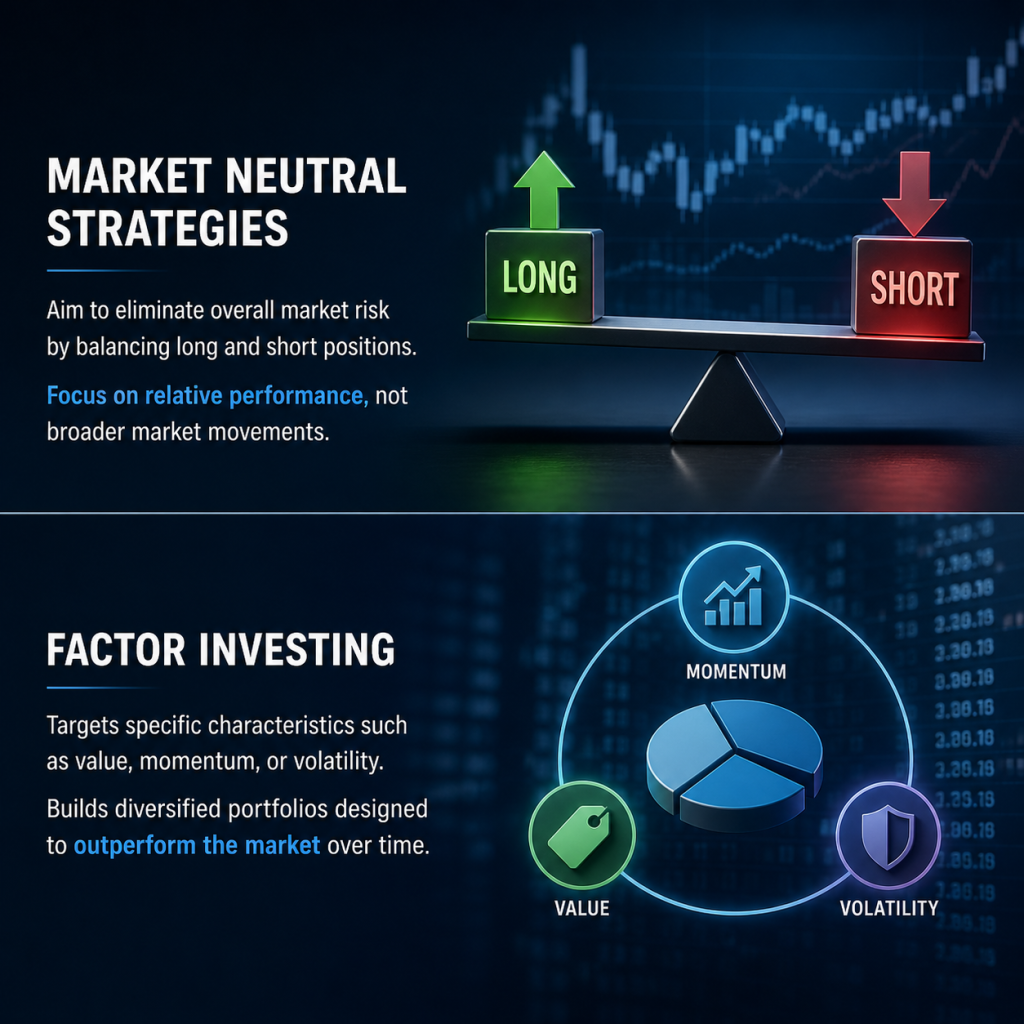
Market Neutral Strategies
Market neutral strategies aim to eliminate overall market risk by balancing long and short positions. This allows traders to focus on relative performance rather than broader market movements.
Factor Investing
Factor investing involves targeting specific characteristics such as value, momentum, or volatility. These factors are used to construct diversified portfolios designed to outperform the market over time.
Key Specializations In Quant Finance
High-Frequency Trading HFT
High-frequency trading focuses on executing trades in extremely short timeframes, often measured in microseconds. Firms in this space rely on advanced infrastructure and low-latency systems (technology designed to minimize delay) to gain a competitive edge.
Market Making
Market makers provide liquidity by continuously quoting buy and sell prices. They profit from the spread between these prices while managing inventory risk. This function is essential for maintaining efficient markets.
Machine Learning And AI Trading
Machine learning and AI-driven strategies analyze vast datasets to identify complex patterns. These systems can adapt dynamically as new data becomes available, making them particularly powerful in rapidly changing environments.
Top Quantitative Trading Firms And Market Makers
Citadel Securities
Citadel Securities is one of the largest market makers in the world, providing liquidity across equities and derivatives markets. The firm is known for its scale and its role in handling a significant portion of retail trading volume. Its strength lies in execution efficiency and technological infrastructure.
Jane Street
Jane Street is a global proprietary trading firm recognized for its expertise in exchange-traded funds and electronic market making. The firm operates with a strong mathematical culture, focusing on pricing efficiency and risk management.
Hudson River Trading HRT
Hudson River Trading is a technology-driven firm specializing in highly automated, low-latency trading systems. Its approach emphasizes engineering excellence and continuous system optimization.
Optiver
Optiver is a global market maker with a strong presence in options and futures markets. The firm is known for its disciplined approach to risk and its ability to provide consistent liquidity.
Jump Trading
Jump Trading operates across multiple asset classes, including equities, futures, and digital assets. It is recognized for its advanced infrastructure and commitment to innovation.
Susquehanna International Group SIG
Susquehanna International Group has a long history in derivatives trading. The firm combines quantitative analysis with probabilistic decision-making to navigate complex markets.
Virtu Financial
Virtu Financial is a publicly traded firm specializing in high-frequency trading and market making. It is known for its ability to generate consistent results across various market conditions.
Tower Research Capital
Tower Research Capital focuses on proprietary high-frequency trading strategies. Its competitive advantage lies in ultra-low latency execution and advanced algorithmic systems.
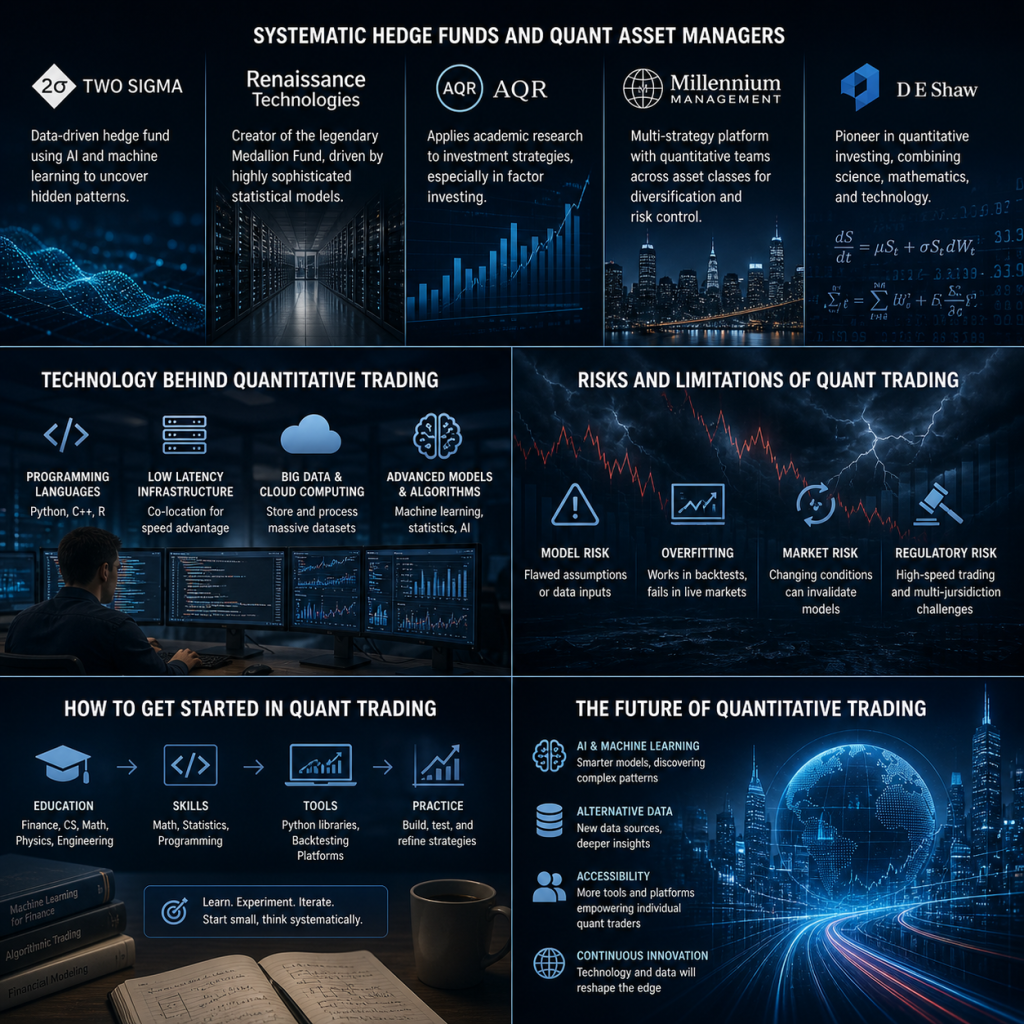
Systematic Hedge Funds And Quant Asset Managers
Two Sigma
Two Sigma is a data-driven hedge fund that uses artificial intelligence and machine learning to analyze massive datasets. Its approach focuses on uncovering patterns that traditional methods may overlook.
Renaissance Technologies RenTech
Renaissance Technologies is widely regarded as one of the most successful quant firms in history. Its Medallion Fund has delivered exceptional returns, driven by highly sophisticated statistical models.
AQR Capital Management
AQR Capital Management applies academic research to investment strategies, particularly in factor investing. The firm translates financial theory into scalable portfolios.
Millennium Management
Millennium Management operates as a multi-strategy platform, allocating capital across numerous teams, including quantitative groups. This structure allows for diversification and risk control.
D E Shaw
D E Shaw is a pioneer in quantitative investing, known for integrating computational methods into finance. The firm has played a significant role in shaping the industry.
Technology Behind Quantitative Trading
Modern quantitative trading is built on advanced technology. Programming languages such as Python, C++, and R are commonly used to develop models and execute strategies. Infrastructure is equally important, particularly for high-frequency trading firms that rely on co-location (placing servers near exchange data centers) to reduce latency. Big data systems and cloud computing allow firms to store and process enormous volumes of information, enabling more sophisticated analysis and faster decision-making.
Risks And Limitations Of Quant Trading
Quantitative trading is not without risks. Model risk arises when assumptions or data inputs are flawed. Overfitting can lead to strategies that perform well in backtests but fail in live markets. Market conditions can change unexpectedly, rendering existing models ineffective. Regulatory challenges also play a role, particularly for firms operating at high speeds or across multiple jurisdictions.
How To Get Started In Quantitative Trading
Entering quantitative trading requires a combination of mathematical, statistical, and programming skills. Common educational backgrounds include finance, computer science, physics, and engineering. Tools such as Python libraries and backtesting platforms make it possible for individuals to develop and test their own strategies. While institutional-level competition is intense, the barrier to entry for learning and experimentation has decreased significantly.
The Future Of Quantitative Trading
The future of quantitative trading is closely tied to advancements in artificial intelligence and data availability. As machine learning models become more sophisticated, they will be able to identify increasingly complex patterns. The use of alternative data will continue to expand, providing new sources of insight. At the same time, more accessible tools may allow individual traders to participate in systematic strategies that were once limited to large institutions.
Frequently Asked Questions
What Is Quantitative Trading In Simple Terms
Quantitative trading uses data, mathematical models, and algorithms to make trading decisions instead of relying on human judgment or intuition.
Is Quantitative Trading Profitable
It can be highly profitable when strategies are well-designed and properly executed, though it involves significant risk and competition.
What Programming Language Is Used In Quant Trading
Python is the most widely used language, along with C++ for high-performance systems and R for statistical analysis.
What Is The Difference Between Algorithmic Trading And Quantitative Trading
Algorithmic trading refers to automated execution, while quantitative trading focuses on the models and strategies that generate trading signals.
Who Are The Biggest Quantitative Trading Firms
Major firms include Citadel Securities, Jane Street, Two Sigma, Renaissance Technologies, and Virtu Financial.
Can Individuals Do Quantitative Trading
Yes, individuals can develop and test their own strategies using modern tools, although competing with large firms requires significant resources.
What Is High Frequency Trading
High-frequency trading involves executing a large number of trades at extremely high speeds, often within microseconds.
How Do Quant Firms Make Money
Quant firms generate profits by identifying patterns, inefficiencies, and statistical opportunities in the market and executing trades based on those insights.
Disclaimer
This content is for informational purposes only and does not constitute financial, legal, or investment advice. Investing involves risk, including potential loss of capital. Readers should conduct their own due diligence and consult with qualified professionals before making any investment decisions. Nothing on this site should be considered an offer or solicitation to buy or sell any securities.