

Retirement portfolios are evolving. Investors are increasingly looking beyond stocks and bonds to manage risk, improve diversification, and address long-term economic uncertainty. Alternative retirement investments have become a central part of that discussion, especially for accredited investors with access to private markets.
Alternative Retirement Investments: Overview
Alternative retirement investments are assets that fall outside traditional public equities and fixed income. These assets often behave differently than public markets and may provide diversification benefits over a full market cycle.
Unlike mutual funds or ETFs, alternatives typically involve private structures, longer holding periods, and different risk profiles. They require more due diligence, but they also offer exposure to return drivers not tied to daily market movements.
Why Investors Are Rethinking Traditional Retirement Portfolios
Market Volatility and Correlation Risk
Public markets have become increasingly correlated, particularly during periods of stress. Equity and bond diversification has not always performed as expected in inflationary or volatile environments.
Alternative investments may reduce reliance on public market performance. This can help smooth portfolio volatility over long time horizons.
Inflation and Purchasing Power Erosion
Inflation directly impacts retirement outcomes. Traditional fixed income may struggle to keep pace with rising costs.
Assets such as real estate, private credit, and certain commodities have historically been viewed as potential inflation hedges. Their cash flow or pricing structures often adjust with economic conditions.
Common Types of Alternative Retirement Investments
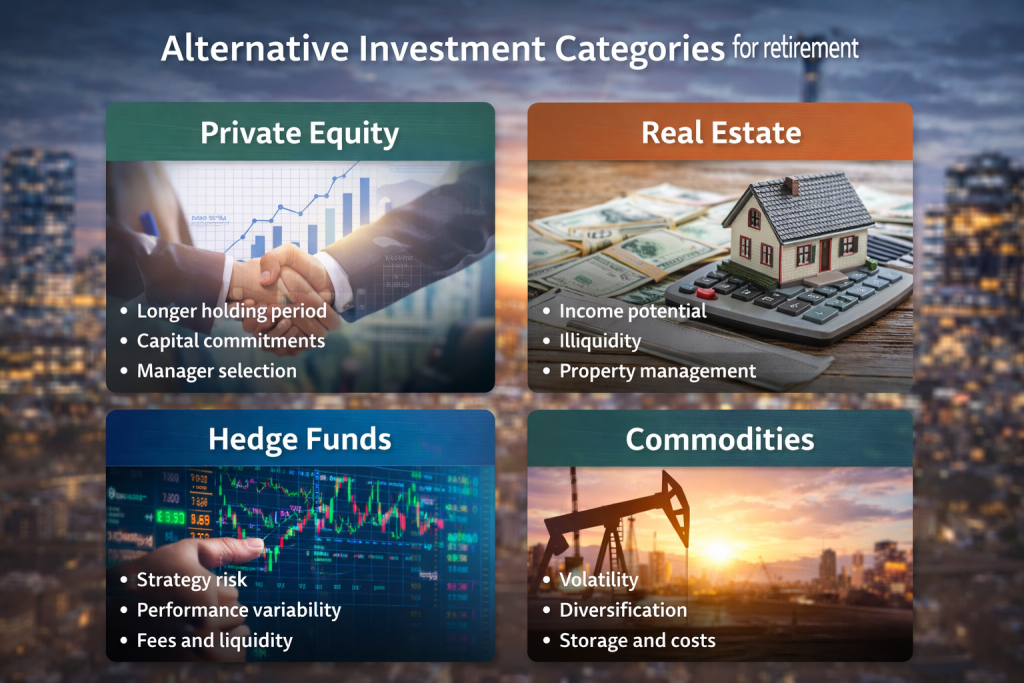
Alternative retirement investments encompass a broad range of asset classes that sit outside traditional stocks, bonds, and mutual funds. These investments are often used by accredited investors to diversify retirement portfolios, reduce reliance on public market performance, and gain exposure to different economic drivers. Unlike traditional assets, alternatives tend to be less liquid, more complex, and highly dependent on manager skill and structure. For retirement accounts in particular, understanding how each category works is essential, since time horizon, cash flow needs, and regulatory constraints all play a critical role. Below are four of the most common alternative investment categories used in retirement strategies, along with the considerations that matter most when allocating long-term capital.
Private Equity and Private Placements
Private equity involves investing directly into privately held companies or private funds that acquire, grow, and eventually exit businesses over a multi-year period. These investments are not traded on public exchanges and typically require long holding periods, often ranging from five to ten years. In a retirement context, private equity is often used for growth-oriented capital rather than income. Returns are driven by operational improvements, strategic acquisitions, and eventual liquidity events such as sales or recapitalizations. Because pricing is not marked daily, private equity valuations can appear more stable than public equities, though the underlying risk remains substantial.
Private placements are closely related and refer to capital raises conducted outside public markets, often under Regulation D exemptions. These offerings may include operating companies, private funds, or structured investment vehicles. For retirement investors using self-directed IRAs, private placements can offer access to opportunities not available through traditional brokerage platforms. However, due diligence is critical. Financial disclosures are limited, exit timelines are uncertain, and investor protections differ from public securities. In retirement portfolios, private equity and private placements are generally best suited for investors with long time horizons, strong liquidity outside retirement accounts, and the ability to tolerate illiquidity and complexity.
Real Estate and Real Estate Syndications
Real estate has long been a cornerstone of alternative investing, particularly for retirement-focused portfolios. Direct real estate ownership can provide income through rents and long-term appreciation tied to property values. Real estate also tends to behave differently than equities, offering potential diversification benefits during certain market cycles. Within retirement accounts, investors often use self-directed IRAs to hold real estate assets, though all expenses and income must flow through the account to remain compliant with IRS rules.
Real estate syndications allow multiple investors to pool capital into larger properties or portfolios managed by experienced sponsors. These structures are common in multifamily, industrial, retail, and mixed-use developments. For retirement investors, syndications offer passive exposure without the operational burden of direct ownership. Cash flow distributions can provide income, while appreciation may occur through value-add strategies or market growth. Risks include leverage, market downturns, sponsor performance, and illiquidity. Since capital is often locked up for several years, real estate investments within retirement accounts should be aligned carefully with long-term planning objectives rather than short-term income needs.
Hedge Funds and Managed Futures
Hedge funds pursue a wide range of strategies designed to generate returns independent of broad market direction. These strategies may include long and short equity positions, event-driven trades, arbitrage, or macroeconomic bets across asset classes. Managed futures strategies typically focus on commodities, currencies, and financial futures using systematic, trend-following models. Both categories aim to deliver risk-adjusted returns and reduce portfolio volatility through diversification.
In retirement portfolios, hedge funds and managed futures are often positioned as defensive or stabilizing components rather than pure growth engines. Their performance depends heavily on manager skill, strategy discipline, and market conditions. Fees are generally higher than traditional investments and can materially impact long-term returns. Liquidity terms vary, with some funds offering periodic redemptions and others imposing extended lockups. For retirement investors, the appeal lies in low correlation to traditional assets, but complexity and transparency remain concerns. Thorough evaluation of strategy fit, risk controls, and alignment with retirement time horizons is essential before allocating capital.
Commodities, Digital Assets, and Tangible Assets
Commodities such as gold, energy, and agricultural products are often used as inflation hedges within diversified portfolios. Their value is tied to real-world supply and demand rather than corporate earnings or interest rates. In retirement strategies, commodities may serve as a defensive allocation, particularly during periods of currency debasement or geopolitical uncertainty. Exposure can be gained through physical holdings, funds, or structured vehicles, each with distinct tax and operational considerations.
Digital assets and tangible assets represent newer and more specialized alternatives. Digital assets, including cryptocurrencies, offer high growth potential but are accompanied by extreme volatility, regulatory uncertainty, and technological risk. Tangible assets such as farmland, timberland, art, or collectibles derive value from physical scarcity and long-term utility. These assets may provide diversification benefits, but they often lack liquidity and standardized valuation. Within retirement accounts, these investments require careful structuring to comply with custodial and regulatory rules. As with all alternatives, allocation size should reflect risk tolerance, liquidity needs, and the investor’s ability to withstand long periods without access to capital.
Using Self-Directed IRAs to Access Alternatives
How Self-Directed Retirement Accounts Work
A self-directed IRA allows investors to hold non-traditional assets within a tax-advantaged structure. The account holder directs all investment decisions.
Custodians administer the account but do not evaluate investment quality. This places responsibility squarely on the investor.
Compliance, Custodians, and Prohibited Transactions
IRS rules strictly prohibit self-dealing and transactions with disqualified persons. Violations can result in severe tax consequences.
Understanding custodial processes and compliance rules is essential before allocating retirement funds to alternatives.
Risks, Liquidity, and Due Diligence Considerations
Illiquidity and Valuation Challenges
Many alternative investments are illiquid. Capital may be locked up for years with limited exit options.
Valuations are often periodic and based on internal models rather than real-time pricing. Investors must be comfortable with reduced transparency.
Regulatory and Tax Considerations
Alternative investments are subject to securities regulations and tax rules that differ from public assets. Accredited investor status is often required under SEC guidelines.
According to the SEC, accredited investors must meet income or net worth thresholds to participate in certain private offerings. Source: SEC Investor.gov.
Who Alternative Retirement Investments Are Best Suited For
Accredited Investors and Long-Term Capital
Alternative retirement investments are best suited for investors with long time horizons and sufficient liquidity outside retirement accounts.
Accredited investors often have the experience and financial flexibility to absorb illiquidity and complexity.
Portfolio Role and Allocation Strategy
Alternatives should complement, not replace, traditional assets. Allocation size should reflect risk tolerance, liquidity needs, and overall objectives.
A disciplined framework is more important than chasing yield or novelty.
Strategic Takeaways for Building a Resilient Retirement Portfolio
Alternative retirement investments can add diversification and broaden opportunity sets when used thoughtfully. They require education, patience, and rigorous due diligence.
The most effective strategies align asset selection with investor profile, regulatory constraints, and long-term planning goals. For a deeper look at private capital structures, visit /private-placements.
Explore more insights on scaling businesses, building strategic partnerships, and navigating modern investment ecosystems at StephenTwomey.com.
Disclosure: This content is for educational purposes only and does not constitute financial, investment, or legal advice. Investors should consult qualified professionals before making investment decisions.