
A 401(k) rollover to Ameritrade can simplify retirement planning while maintaining tax advantages. This guide breaks it down clearly for accredited investors and financial professionals.
What is an Ameritrade 401K Rollover
An Ameritrade 401K rollover moves assets from a former employer’s 401(k) into an Individual Retirement Account (IRA) at TD Ameritrade or Charles Schwab (which now includes Ameritrade accounts). This process maintains the tax-deferred status of your retirement savings.
Why Consider Rolling Over Your 401(k) to an Ameritrade IRA
Investment Options and Control
Rolling over into an Ameritrade IRA gives access to a broad investment menu. You can choose mutual funds, ETFs, equities, bonds, and alternative strategies not available in many employer plans.
Fees, Tax Efficiency and Growth Potential
Ameritrade offers no annual maintenance fee on rollover IRAs. A direct rollover avoids withholding and potential penalties, preserving more capital for growth.
Creditor Protection & Retirement Strategy
Employer plans often have stronger federal protections. IRAs have protections that vary by state. Review these differences before rolling over.
Ameritrade 401K Rollover Step-by-Step
Rolling over a 401(k) to an Ameritrade IRA is a strategic decision that can materially affect portfolio control, tax efficiency, and long-term wealth outcomes. For accredited investors, the process goes beyond administrative steps and becomes part of a broader capital allocation strategy. Understanding eligibility rules, rollover mechanics, and post-transfer investment decisions is essential to avoid costly errors. A well-executed rollover preserves tax advantages while positioning capital for more flexible and sophisticated investment opportunities. The following steps outline a disciplined approach designed for investors who prioritize precision, compliance, and long-term planning.
Confirm Eligibility and Account Type
The first step is confirming that your existing 401(k) plan allows a rollover. Most plans permit rollovers after separation from service, though some also allow in-service rollovers once certain age thresholds are met. This must be verified directly with the plan administrator. At the same time, identify the tax classification of your assets. Traditional 401(k) contributions and earnings are pre-tax, while Roth 401(k) assets are funded with after-tax dollars. This distinction determines the type of IRA you must open at Ameritrade.
Traditional assets should generally roll into a Traditional IRA to avoid triggering a taxable event. Roth assets should roll into a Roth IRA to preserve tax-free growth. Mixing account types without planning can create unexpected tax exposure. Accredited investors often hold large balances, which makes precision at this stage critical. Proper alignment of account types preserves tax deferral and avoids unnecessary friction with IRS reporting requirements.
Choose Between Direct and Indirect Rollovers
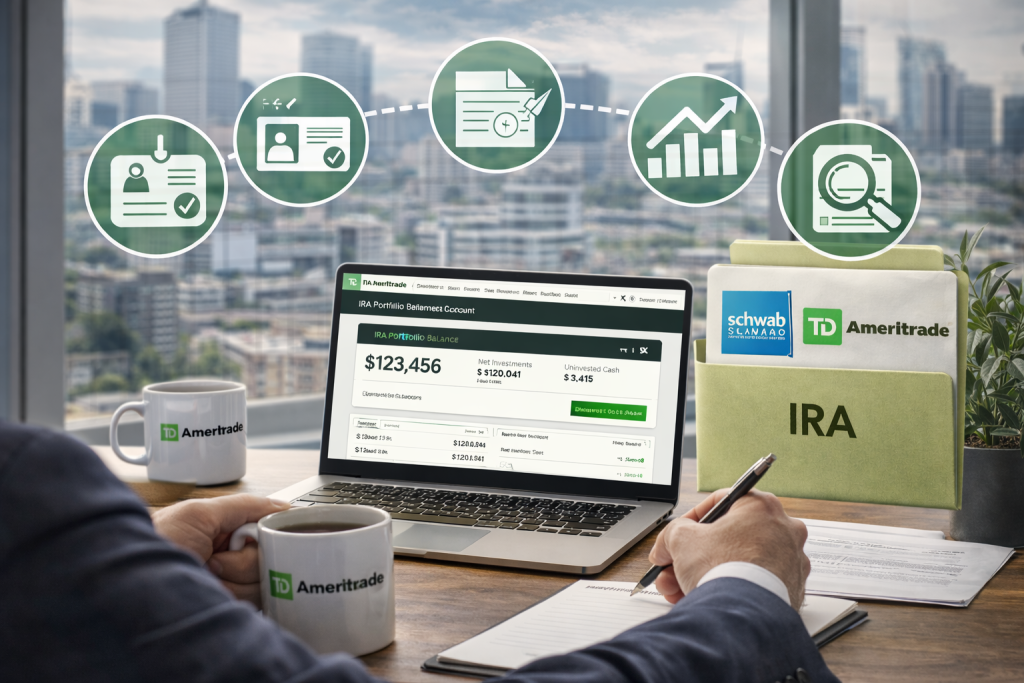
Selecting the correct rollover method is one of the most important decisions in the process. A direct rollover, also called a trustee-to-trustee transfer, moves funds directly from the 401(k) custodian to the Ameritrade IRA. This method avoids mandatory withholding and eliminates the risk of accidental distribution. An indirect rollover sends the funds to you personally, after which you have 60 days to redeposit the full amount into an IRA.
This option introduces multiple risks. The plan administrator is required to withhold 20 percent for federal taxes, meaning you must replace that amount out of pocket to complete a full rollover. Failure to meet the 60-day deadline results in the distribution being treated as taxable income, with potential penalties if you are under the applicable age threshold. For accredited investors managing significant capital, indirect rollovers rarely make sense. Direct rollovers provide cleaner execution, stronger compliance, and far less downside risk.
Initiating the Transfer with Ameritrade
Once the account structure and rollover method are confirmed, the transfer process can begin. Open the appropriate IRA at Ameritrade and request its rollover documentation. Ameritrade will provide clear instructions for submitting transfer requests to your existing plan administrator. In most cases, the administrator will issue a check payable directly to the new custodian for the benefit of your IRA. This detail matters, as checks made payable to you personally can be misclassified as distributions.
Throughout the process, maintain records of all communications, forms, and confirmations. Accredited investors often coordinate this step with legal or tax advisors to ensure consistency with broader planning strategies. Timing also matters. Some plans process rollovers quickly, while others take several weeks. Understanding the timeline helps avoid gaps where assets sit idle or exposed to unnecessary administrative risk. Precision and documentation at this stage protect both capital and compliance.
Investing Your Rollover Funds
After the rollover is complete, funds often arrive in the IRA as uninvested cash. This is a critical transition point. Leaving capital idle for extended periods introduces opportunity cost and inflation risk. Ameritrade provides access to a wide range of public market investments, including equities, ETFs, fixed income, and structured strategies.
For accredited investors, this is also the moment to align the IRA with a broader portfolio construction plan. Asset allocation should reflect risk tolerance, liquidity needs, and time horizon, not simply replicate the old 401(k) lineup. Some investors use this flexibility to consolidate accounts, rebalance exposures, or integrate alternative investment strategies where permitted.
Every investment decision inside the IRA should be evaluated through a tax-aware lens, as trading activity, income generation, and future withdrawals interact with long-term planning goals. Thoughtful deployment of rollover funds transforms a procedural step into a strategic advantage.
Tax Rules, Penalties and IRS Requirements
60-Day Rollover Rule Explained
If you receive distribution directly, the IRS gives 60 days to deposit it into a qualified account. Missing this window triggers ordinary income tax and possible early withdrawal penalties.
Traditional vs Roth Rollovers
A traditional 401(k) to Roth IRA conversion triggers current taxes but allows future tax-free qualified withdrawals. Match account types when possible to avoid unexpected tax bills.
Common Tax Mistakes to Avoid
Avoid indirect rollovers that trigger 20 percent withholding and missing the 60-day window. Align rollover type with long-term tax strategy.
Ameritrade 401K Rollover Pros and Cons
Pros
- Access to broad investment choices
- Maintains tax advantages
- Control over allocation
Pros
- Potential loss of some plan-specific protections
- Responsibility for investment decisions
Key Risks and Practical Considerations
Consider plan fees, your investment maturity timeline, and whether a new employer plan may offer benefits worth keeping consolidated.
FAQs About Ameritrade 401K Rollovers
Q. Does Ameritrade charge rollover fees?
In most cases no, but check with Ameritrade support as account setup or custodian fees vary.
Q. Can I roll over while still employed?
Some plans allow in-service distributions, but this depends on plan rules.
Conclusion and Next Steps
A thoughtfully executed Ameritrade 401K rollover can boost investment options and streamline retirement accounts. Always consult tax and financial professionals to align strategy with long-term goals.
For more insights on business development, capital growth strategies, and the evolving landscape of private markets, visit StephenTwomey.com — where strategy meets execution.
Disclosure: None of the content here is financial advice.