
A TD Ameritrade 401K rollover is one of the most common decisions investors face when changing jobs or refining long term strategy. While the process appears simple, the implications can affect taxes, flexibility, and investment access for decades. Understanding how rollovers work is essential for informed capital allocation.
What is a TD Ameritrade 401K Rollover: A Guide for Accredited Investors
A TD Ameritrade 401K rollover refers to the process of moving assets from an employer sponsored 401k plan into an individual retirement account held at TD Ameritrade, now operating under the Charles Schwab umbrella. For accredited investors, this decision is rarely administrative. It is strategic.
A rollover typically occurs after a job change, retirement, or corporate restructuring, and it creates an opportunity to reassess how retirement capital is structured, managed, and deployed. Unlike many employer plans that limit participants to a narrow menu of mutual funds, a rollover IRA can provide access to a far broader investment universe.
This may include individual equities, ETFs, fixed income instruments, and in some cases pathways toward more advanced or self directed strategies. The core appeal lies in control. Accredited investors often prioritize flexibility, transparency, and alignment with broader wealth planning objectives. A TD Ameritrade 401K rollover can consolidate fragmented retirement assets into a single custodial framework, simplify oversight, and allow for more deliberate portfolio construction that reflects long term risk tolerance rather than plan defaults.
For accredited investors, the importance of how a TD Ameritrade 401K rollover is executed cannot be overstated. The distinction between a direct rollover and an indirect rollover has meaningful tax and compliance implications. A properly structured direct rollover moves funds from the plan administrator to the IRA custodian without the investor taking possession, preserving tax deferral and avoiding unnecessary withholding. Indirect rollovers, while permitted under IRS rules, introduce timing risk and potential penalties if deadlines are missed or amounts are mishandled.
Beyond mechanics, accredited investors often view rollovers as a gateway decision. Once assets sit inside an IRA structure, they can be positioned more intentionally within a broader capital allocation strategy that may include taxable accounts, business interests, and alternative investments. This does not mean increased risk by default. It means optionality. A TD Ameritrade 401K rollover gives sophisticated investors the ability to align retirement capital with their overall financial architecture, rather than treating it as a siloed account governed by legacy plan constraints.
TD Ameritrade and the Schwab Integration
Charles Schwab acquired TD Ameritrade, creating understandable confusion among investors. Retirement accounts, including rollover IRAs, continue to function with minimal disruption.
Account structures, custodial protections, and IRS reporting requirements remain consistent. The primary change is platform branding and long term integration, not ownership of assets.
TD Ameritrade 401K Rollover Options
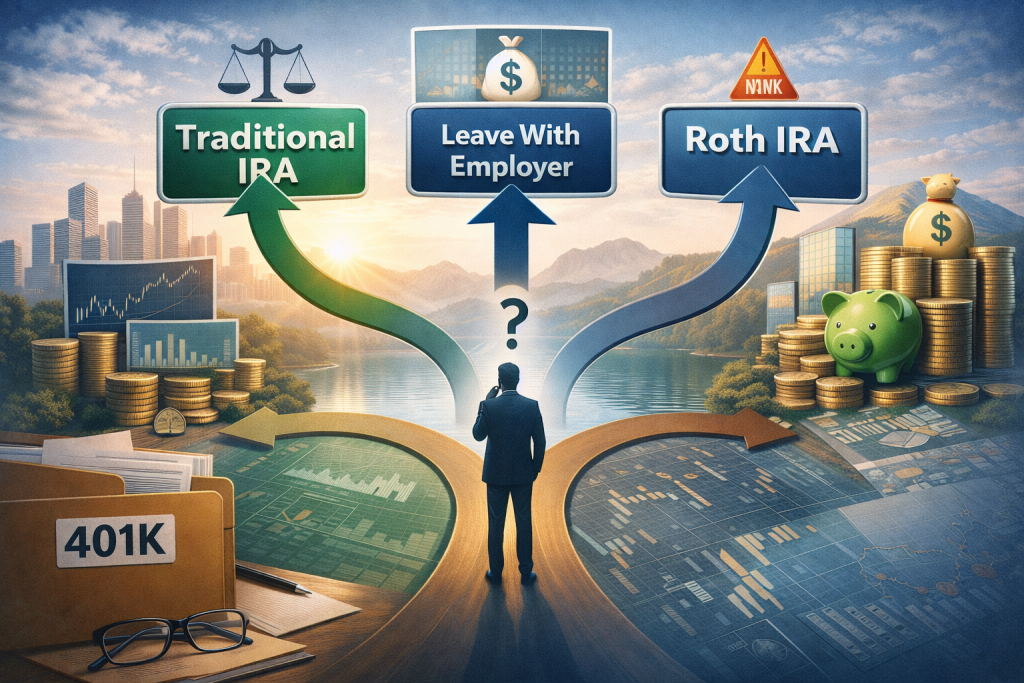
Choosing how to handle a 401K after leaving an employer is a strategic decision, not an administrative one. A TD Ameritrade 401K rollover presents three primary paths, each with distinct tax, flexibility, and long term planning implications. The right option depends on income expectations, investment preferences, and how actively an investor wants to manage capital.
Understanding the tradeoffs between rolling into a Traditional IRA, converting to a Roth IRA, or leaving assets with a former employer is essential before initiating any transfer. Each choice shapes not only tax exposure but also portfolio construction and future optionality.
Rolling Over to a Traditional IRA
Rolling a 401K into a Traditional IRA at TD Ameritrade is the most common rollover strategy. This option preserves the tax deferred status of retirement assets, meaning no immediate taxes are owed when the rollover is executed correctly as a direct transfer. For investors who anticipate being in a lower tax bracket later in life, this structure often aligns well with long term withdrawal planning. A Traditional IRA also provides broader investment flexibility compared to most employer sponsored plans.
Investors gain access to individual equities, ETFs, and more sophisticated allocation strategies that are often unavailable inside a 401K. Another advantage is account consolidation, which simplifies required minimum distributions and ongoing oversight as portfolios grow. However, distributions taken in retirement are taxed as ordinary income, and required minimum distributions apply once age thresholds are reached. This option favors investors focused on control, flexibility, and tax deferral rather than near term tax optimization.
Rolling Over to a Roth IRA
A rollover from a 401K into a Roth IRA involves converting pre tax assets into an after tax structure. This means taxes are typically due in the year the conversion occurs, which can be significant depending on account size and income level. Despite the upfront tax cost, many investors view Roth conversions as a long term planning tool rather than a short term decision. Qualified Roth IRA withdrawals are generally tax free, and there are no required minimum distributions during the original owner’s lifetime.
This can create meaningful flexibility for retirement income planning and estate considerations. A Roth IRA at TD Ameritrade also allows access to the same broad investment universe as a Traditional IRA. This structure is often favored by investors who expect higher future tax rates or who want to minimize tax uncertainty decades from now. Timing, income management, and coordination with other tax strategies are critical when considering this option.
Leaving Assets with a Former Employer
Leaving assets in a former employer’s 401K plan is sometimes the simplest option, but simplicity does not always equal efficiency. Some plans offer institutional pricing, stable value funds, or unique investment options that may be difficult to replicate elsewhere.
For investors satisfied with the plan’s structure and investment menu, leaving assets in place can be reasonable in the short term. However, employer plans often have limited investment flexibility, higher administrative constraints, and less customization compared to an IRA at TD Ameritrade. Managing multiple old 401K accounts can also complicate portfolio oversight and retirement planning over time. Required minimum distributions may become harder to track across multiple custodians.
In addition, plan rules can change, and access to guidance may be limited once employment ends. This option is generally best viewed as temporary rather than a long term strategy for investors seeking control and adaptability.
Step by Step TD Ameritrade 401K Rollover Process
Opening the Correct IRA
The process begins by opening a rollover IRA at TD Ameritrade. The account type must match the intended tax treatment.
This step establishes the receiving custodian before any funds move.
Initiating a Direct Rollover
A direct rollover moves funds from the plan administrator to the IRA custodian. The investor never takes possession of the money.
This method avoids withholding taxes and reporting errors. It is the preferred approach for most rollovers.
Avoiding Indirect Rollover Mistakes
Indirect rollovers send funds to the investor first. The IRS allows a 60 day window to redeposit funds.
Missed deadlines or withholding errors can trigger taxes and penalties. This path introduces unnecessary complexity.
Tax Considerations and Common Pitfalls
Direct vs Indirect Rollovers
Direct rollovers are not taxable events. Indirect rollovers may result in temporary withholding and potential penalties.
The structure matters more than the destination.
Early Withdrawal Penalties
Funds withdrawn before age thresholds may incur penalties if not rolled correctly. A rollover is not a withdrawal when executed properly.
Precision in paperwork protects capital.
Required Minimum Distribution Implications
Rollovers can affect future required minimum distributions. Consolidating accounts simplifies compliance and planning.
Understanding timing rules is essential for older investors.
TD Ameritrade 401K Rollover vs Other Brokerages
TD Ameritrade vs Fidelity
Fidelity offers strong retirement tools but often emphasizes proprietary funds. TD Ameritrade historically emphasized open architecture and trading flexibility.
Investor preference depends on control versus packaged solutions.
TD Ameritrade vs Vanguard
Vanguard is known for passive investing and low cost index funds. TD Ameritrade appeals to investors seeking customization and broader asset access.
TD Ameritrade vs Schwab
Post acquisition, distinctions are narrowing. Schwab’s scale combines with TD Ameritrade’s platform depth, creating a robust custodial environment.
How Sophisticated Investors Use Rollovers Strategically
Expanding Investment Flexibility
A rollover IRA opens access to ETFs, individual securities, and advanced strategies not available in many employer plans.
This flexibility supports customized risk management and asset allocation.
Integrating Rollovers With Alternative Assets
Some investors use rollovers as a gateway to self directed strategies. These may include private placements, real estate, or other alternative investments.
For a deeper discussion on non traditional strategies, see /alternative-investments.
Is a TD Ameritrade 401K Rollover Right for You
A TD Ameritrade 401K rollover is not a default decision. It is a strategic one.
Investors should consider control, tax impact, long term objectives, and administrative simplicity. The right choice aligns capital with intent, not convenience.
Explore more insights on scaling businesses, building strategic partnerships, and navigating modern investment ecosystems at StephenTwomey.com.
Disclosure: This article is for educational purposes only. None of the content on this site constitutes financial, tax, or investment advice. Readers should consult qualified professionals before making financial decisions.