
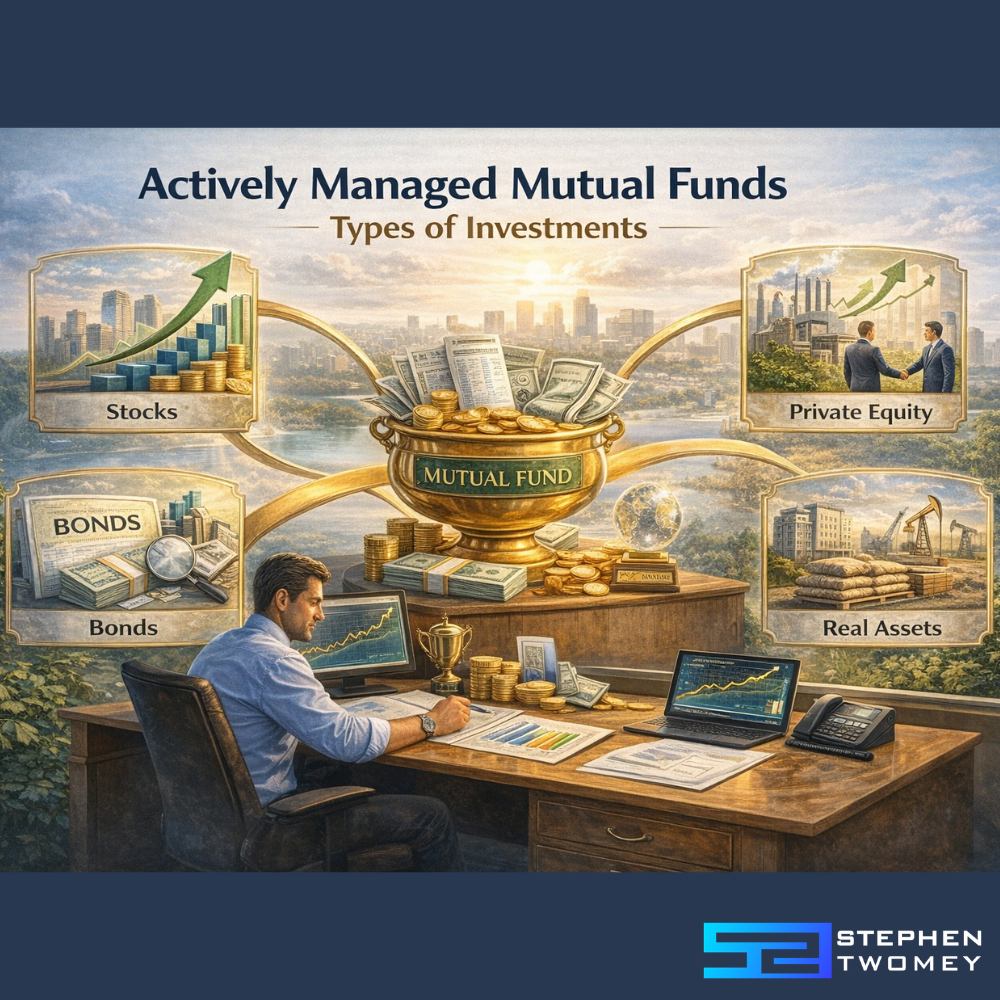
Actively managed mutual funds sit at the intersection of professional judgment and market competition. They offer a structured way to invest in stocks, bonds, and more, while relying on a manager’s skill to outperform a benchmark. For business owners and high-income investors, understanding how these funds work can sharpen decision-making across broader wealth and capital allocation strategies.
What Are Actively Managed Mutual Funds?
An actively managed mutual fund is a pooled investment vehicle run by a professional manager who selects and trades securities to outperform a benchmark or achieve a specific objective. The SEC describes an actively managed fund as one that relies on the skill of an investment adviser to manage the portfolio, rather than simply tracking an index. Investor.gov
Active funds are common in retirement accounts, brokerage portfolios, and institutional allocations. They also influence how investors think about private market opportunities. The same principle applies: skill must justify cost.
Why active management exists
The logic is simple. Markets are not always efficient. Information is uneven. Liquidity changes. Behavioral bias moves prices. Active managers try to exploit those conditions using research and risk controls.
Authority snippet:
“Active management is not free. The fee is the hurdle rate you must beat before you win.”
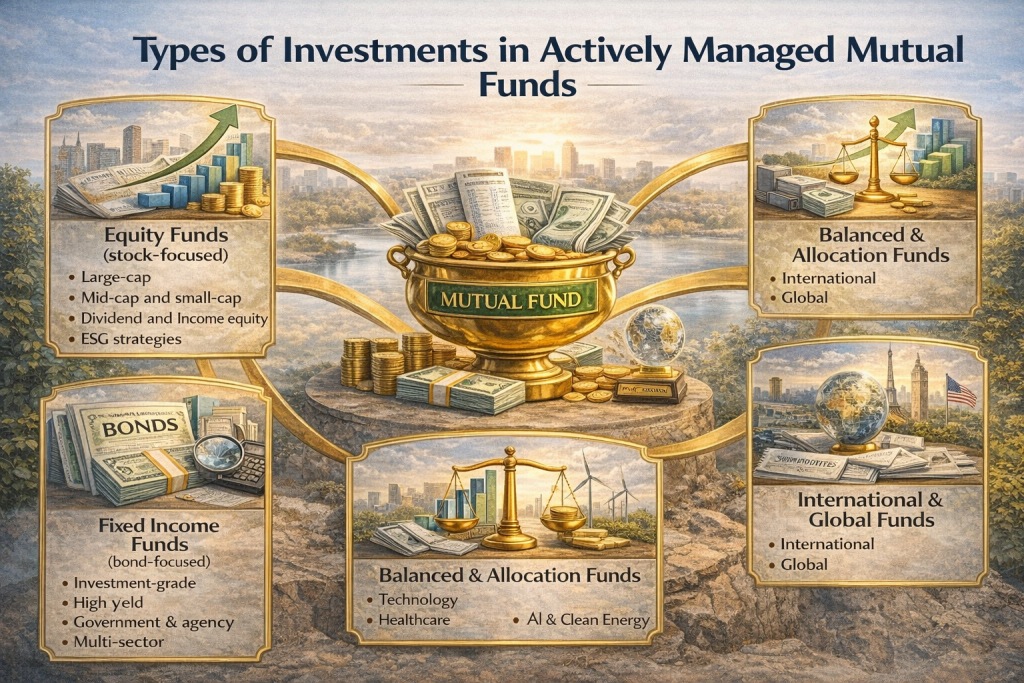
Types of Investments in Actively Managed Mutual Funds
The phrase “actively managed mutual funds types of investments” can sound technical. In practice, it means one thing: active management can be applied across many asset classes, not just stock picking.
Equity funds (stock-focused)
Equity funds invest primarily in stocks. The manager makes decisions about:
- company selection
- sector weighting
- valuation discipline
- timing and position sizing
Common sub-types include:
- Large-cap growth and value
- Mid-cap and small-cap
- Dividend and income equity
- ESG or factor-based strategies
Real-world example:
A manager might overweight cash-flow-rich industrials during a high-rate cycle, and reduce exposure to long-duration tech when valuations compress.
Fixed income funds (bond-focused)
Bond markets are large, complex, and often less transparent than equity markets. This is one reason active management can sometimes be more defensible in fixed income.
Active bond fund categories include:
- Investment-grade corporate
- High yield
- Municipal
- Government and agency
- Multi-sector and unconstrained bond funds
Business case insight:
Many advisors use active bond funds as a volatility buffer. The manager’s job is not just yield, it is avoiding credit blowups and managing duration risk when rates shift.
Balanced and allocation funds
Balanced funds combine stocks and bonds inside one wrapper. The manager may adjust allocations as conditions change. Think of these as “portfolio-in-a-product.”
They are often used by:
- investors who want simplicity
- retirement savers
- business owners who want a set-and-review approach
Sector and thematic funds
These funds concentrate on an industry or theme, such as:
- technology
- healthcare
- energy
- infrastructure
- AI and semiconductors
- clean energy
They are often volatile. Used well, they can be a tactical tool. Used poorly, they become a performance chase.
Authority snippet:
“Performance without context is marketing. Performance versus a benchmark is analysis.”
International and global funds
International funds invest outside the investor’s home country. Global funds invest both inside and outside. Active management can matter here because:
- accounting standards differ
- currency adds risk
- regional cycles diverge
- information flow is uneven
A skilled manager may reduce exposure to political risk, or hedge currency to protect returns.
Alternative and non-traditional strategy funds
Some mutual funds use alternative approaches, including:
- long-short equity
- market neutral
- managed futures
- liquid alternatives
- commodity exposure
These funds aim for diversification and risk-adjusted outcomes, not necessarily maximum upside. They are relevant to accredited investors because they overlap with the logic of private funds, but in a regulated public wrapper.
For readers building broader allocations, you can also explore /alternative-investments for how this thinking extends into private capital.
How Actively Managed Mutual Funds Work (The Operating System)
Active mutual funds are defined by process. The fund’s outcomes depend on how the manager sources ideas, builds a portfolio, and manages risk under pressure.
The fund manager’s process
Most managers follow some combination of:
- bottom-up company research
- top-down macro positioning
- factor and quantitative screens
- risk modeling and scenario testing
The best managers can explain their edge in one sentence, then prove it in execution.
Portfolio construction and rebalancing
Active funds differ in concentration:
- some hold 30 to 60 positions
- others hold 200+ and behave closer to an index
Portfolio rules matter. A high-conviction fund can outperform dramatically, but it can also underperform sharply. The manager’s discipline is the product.
Turnover, trading costs, and taxes
Turnover is how often a fund buys and sells holdings. Higher turnover usually means:
- higher trading costs
- potentially higher taxable distributions
Many investors focus on the expense ratio and ignore turnover. That is a mistake, especially in taxable accounts.
Authority snippet:
“Turnover is not just trading. In taxable accounts, it is a tax strategy whether you planned it or not.”
Actively Managed vs Passive Funds (What Actually Changes)
Passive funds track an index. Active funds try to beat one. The debate is often emotional. The better approach is analytical.
Fees and the hurdle rate
Active funds cost more. The expense ratio is the visible cost. Turnover and taxes are the less visible costs.
A practical way to think about it:
- If a fund charges 1% annually, the manager must generate at least 1% of excess return just to break even versus a comparable index fund.
- That is the hurdle rate.
Risk-adjusted performance and benchmark choice
Always compare the fund to the correct benchmark.
- A “large-cap growth” fund should not be compared to the S&P 500.
- A multi-sector bond fund should not be compared to a government bond index.
Use risk-adjusted metrics:
- Sharpe ratio
- standard deviation
- max drawdown
- downside capture
Where active tends to be more defensible
Research firms often show that active success rates vary by category. In some areas, active funds have historically performed better relative to passive, while in other areas they lag. Morningstar’s “Active/Passive Barometer” framework is a widely cited example of this category-by-category reality. Morningstar
In practice, active tends to be more defensible when:
- markets are less efficient
- benchmarks are hard to replicate
- credit selection matters
- volatility creates opportunity
Benefits of Actively Managed Mutual Funds
Active funds can add value. The key is choosing where active has a rational job to do.
Flexibility in volatility
When markets break, indexes do not adapt. Active managers can raise cash, rotate sectors, or reduce exposure to deteriorating fundamentals.
This can be useful for business owners and entrepreneurs who already have concentrated risk in their operating company.
Risk management and downside capture
The best active managers often win through loss avoidance. Avoiding a major drawdown can compound results over time, even if bull-market performance is merely average.
Access to institutional-style research
Top firms run deep analyst teams. As a retail investor, you get access to that research through the fund wrapper.
Risks and Drawbacks (What Investors Underestimate)
The case against active funds is not that they never work. It is that many investors choose them for the wrong reasons.
Expense ratios and hidden trading costs
A 1.25% expense ratio is not just a fee. It is an annual performance headwind.
Some funds also have:
- redemption fees
- loads (less common today, but still present in some share classes)
Manager risk and style drift
You are not only buying the fund. You are buying the manager’s decisions.
Key risks:
- the manager leaves
- the firm changes process
- the fund grows too large
- the strategy drifts from its stated mandate
Tax inefficiency
Active mutual funds can distribute taxable capital gains, even if the investor did not sell shares. This matters most in taxable accounts.
Closet indexing
Closet indexing occurs when a fund charges active fees but stays close to the benchmark. That can be one of the worst outcomes for investors.
Authority snippet:
“If a fund charges active fees but behaves like an index, you are paying extra for sameness.”
How to Evaluate an Actively Managed Mutual Fund (A Practical Checklist)
This is where sophisticated investors separate product marketing from real strategy.
1) Start with cost: expense ratio and turnover
- Compare expense ratio to category average
- Check turnover ratio
- In taxable accounts, review distribution history
A high-fee, high-turnover fund has to work harder to justify itself.
2) Manager tenure and repeatable process
Look for:
- long tenure
- consistent philosophy
- evidence that performance is tied to process, not luck
If a fund only looks good during one market regime, treat it with caution.
3) Performance versus benchmark over full cycles
Use at least:
- 5-year history, ideally 10-year
- multiple market environments
- comparisons to both benchmark and category peers
4) Concentration and risk metrics
Study:
- top 10 holdings concentration
- sector exposure
- standard deviation
- drawdowns
A fund can outperform while taking far more risk than it admits.
5) Tax considerations
If you hold the fund in a taxable account:
- watch for capital gains distributions
- consider tax-managed share classes if available
- evaluate whether an ETF version exists
6) Fit inside your overall wealth strategy
An active fund should have a role:
- core equity
- bond stabilizer
- tactical satellite
- diversifier
If you cannot describe the role, you do not have a strategy. You have a holding.
When Actively Managed Mutual Funds Make Sense (Strategic Use Cases)
Active funds can be useful when deployed intentionally.
Core vs satellite portfolio roles
A common professional framework:
- Core: low-cost index funds
- Satellite: selected active funds where skill can matter
This limits fee drag while still allowing active bets.
High-income and bond strategies
Active bond funds may help with:
- credit selection
- duration management
- sector rotation
In changing rate environments, this can be meaningful.
Tactical exposure for accredited investors
For accredited investors who also evaluate private placements, active mutual funds can serve as:
- liquid exposure while waiting for private capital calls
- diversifiers alongside private credit or real estate
- risk-managed sleeves for public market exposure
Final Takeaway: How to Use Active Funds Like a Professional
Actively managed mutual funds are not automatically good or bad. They are tools. The professional way to use them is simple: define their job, measure them against the right benchmark, and treat costs as a performance hurdle.
If you approach active funds with the same discipline you would apply to private placements and alternative strategies, you will make better decisions, and avoid paying for complexity that does not deliver value.
Disclosure: None of the content on this article or site is financial advice. It is educational information only. Always consult a qualified financial professional before making investment decisions.
For in-depth analysis on private market dynamics, business strategy, and capital formation, visit StephenTwomey.comfor ongoing research and commentary.