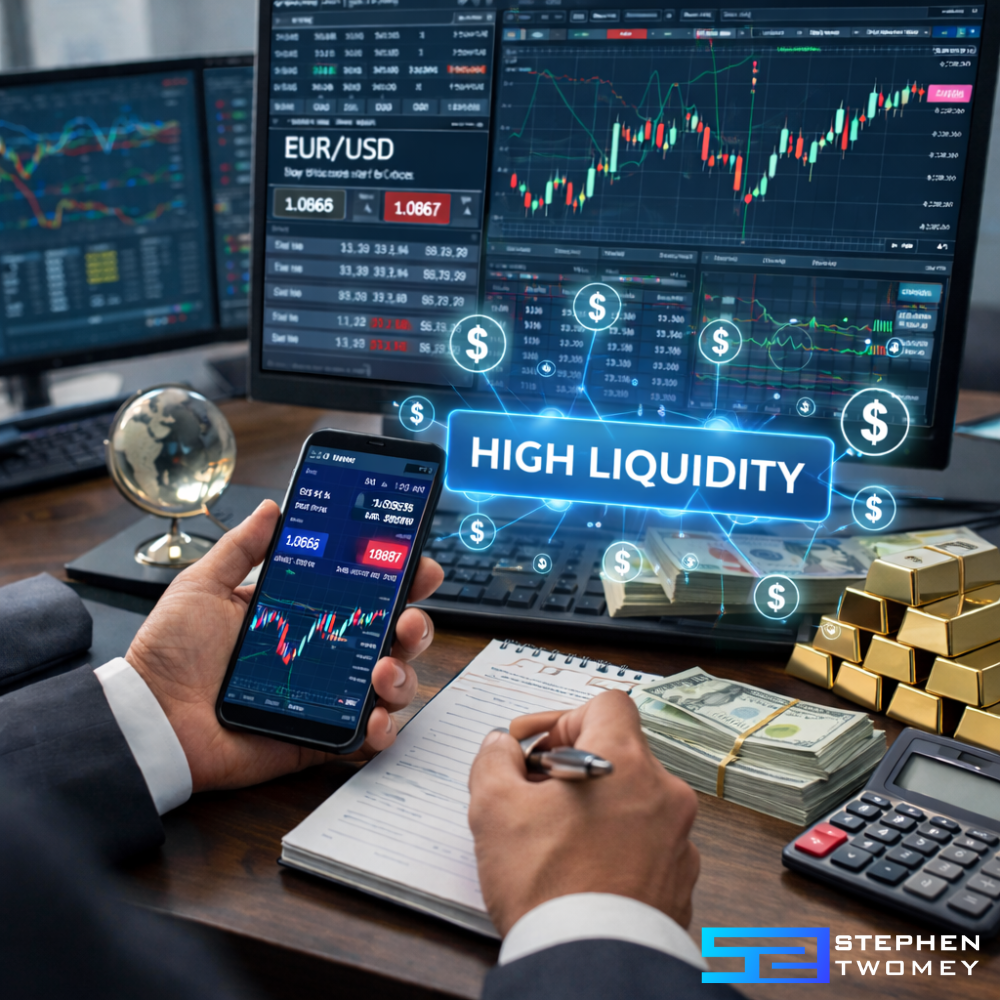
Forex trading is the exchange of one currency for another on a global market. It remains the largest financial market in the world with deep liquidity and continuous access.
Forex presents distinct advantages for traders and investors who understand market dynamics.
What is Forex Trading
The Forex Market Defined
Forex trading refers to the buying and selling of currencies in the global foreign exchange market. It is the largest and most liquid financial market in the world, with daily trading volume measured in trillions of dollars. Transactions occur over the counter rather than on a centralized exchange, with pricing driven by supply, demand, interest rate expectations, and macroeconomic data. Currency pairs such as EUR/USD or USD/JPY represent the relative value of one currency against another, creating opportunities from both rising and falling price movements.
For accredited investors, forex trading functions as a strategic market rather than a speculative novelty. Its deep liquidity, continuous price discovery, and global participation make it attractive for capital deployment, hedging, and tactical positioning. Unlike traditional equity markets, forex allows efficient short exposure without complex derivatives and provides access to macroeconomic themes such as monetary policy shifts, geopolitical risk, and global growth cycles. When approached with disciplined risk management, forex trading can serve as a complementary component within a diversified alternative investment strategy rather than a standalone trading activity.
The market’s scale and decentralization set it apart from stocks or commodities.
Core Advantages of Forex Trading for Accredited Investors
Forex trading offers structural advantages that align well with the objectives of accredited investors seeking flexibility, efficiency, and access to global macro opportunities. Unlike many alternative investments, the forex market operates continuously, maintains deep liquidity, and allows sophisticated positioning across economic cycles. These characteristics make it suitable not as a speculative sideline, but as a tactical and strategic allocation within a broader wealth framework. When approached with institutional discipline, forex trading can support capital preservation, opportunistic returns, and portfolio diversification in ways that traditional asset classes often cannot.
High Market Liquidity
High market liquidity is one of the most significant advantages of forex trading for accredited investors. The foreign exchange market processes trillions of dollars in daily volume, which means large positions can typically be entered or exited without materially impacting price. This depth reduces slippage, improves execution quality, and allows investors to scale exposure efficiently. For accredited investors managing larger capital bases, liquidity is not a convenience. It is a risk control mechanism. Liquid markets enable faster responses to macroeconomic data, central bank decisions, and geopolitical developments. They also allow for tighter spreads in major currency pairs, which directly lowers trading friction over time.
In contrast to private markets or thinly traded securities, forex liquidity supports tactical reallocation without lockups or gating risk. This flexibility is especially valuable during periods of market stress, when liquidity often disappears elsewhere. In practical terms, liquidity allows forex to function as a responsive tool rather than a static investment. For investors accustomed to private equity or private credit timelines, this real-time access can materially change how risk and opportunity are managed.
24-Hour Global Market Access
The forex market operates 24 hours a day, five days a week, following the global cycle of financial centers. For accredited investors, this continuous access offers strategic advantages that are rarely available in traditional markets. Currency prices respond in real time to economic releases, policy announcements, and geopolitical events, regardless of local exchange hours. This allows investors to adjust exposure as information emerges, rather than waiting for market opens. It also supports global diversification, since positions can reflect developments in Asia, Europe, or North America as they occur.
From a portfolio management perspective, continuous access reduces overnight gap risk that is common in equities. It also enables more precise timing around macro catalysts such as central bank meetings or inflation data. For investors operating across time zones or managing international exposure, the 24-hour structure aligns naturally with global capital flows. This round-the-clock market access transforms forex from a passive holding into an active risk management instrument, capable of responding to evolving conditions without artificial constraints imposed by exchange hours.
Low Barriers to Entry
Forex trading has relatively low structural barriers to entry compared with many alternative investments. While accredited investors may deploy substantial capital, the market itself does not require large minimum commitments, lengthy onboarding, or complex ownership structures. Accounts can be opened efficiently, capital can be allocated incrementally, and exposure can be adjusted without renegotiation or lock-in periods. This accessibility does not diminish the sophistication of the market. Instead, it provides flexibility in how capital is deployed.
Accredited investors can test strategies, allocate tactically, or integrate forex exposure alongside other investments without committing to long-term illiquidity. The availability of institutional-grade platforms, data feeds, and execution tools further supports professional participation. Importantly, low barriers to entry do not imply low risk. They simply mean the market is operationally efficient. For experienced investors, this efficiency allows capital to remain mobile and responsive. In an environment where many alternatives require patience and illiquidity premiums, forex offers optionality. Capital can be redeployed quickly as opportunities shift, which is increasingly valuable in volatile macro conditions.

Leverage and Margin Opportunities
Leverage and margin are often misunderstood aspects of forex trading, but for accredited investors they represent tools rather than temptations. Leverage allows an investor to control larger nominal positions with a smaller amount of committed capital. When used conservatively, this can improve capital efficiency and free liquidity for other allocations. The key distinction lies in intent and discipline. Professional investors use leverage to fine-tune exposure, hedge risk, or express macro views with precision, not to speculate recklessly.
Margin requirements in forex are transparent and dynamically adjusted, providing clear visibility into risk. This contrasts with implicit leverage embedded in other asset classes, such as real estate or structured products, where risk may be less obvious. Proper position sizing, stop-loss frameworks, and portfolio-level risk limits are essential. When these controls are in place, leverage becomes a strategic instrument rather than a liability. For accredited investors accustomed to leverage in private markets, forex offers a more flexible and transparent environment in which to manage exposure.
Ability to Go Long and Short
The ability to go long and short with equal ease is a core structural advantage of forex trading. Every currency pair inherently represents a long position in one currency and a short position in another. This symmetry allows accredited investors to express views on relative economic strength, interest rate differentials, and policy divergence without relying on derivatives or complex instruments. Short exposure does not require borrowing shares or navigating limited availability. It is native to the market. This makes forex particularly well suited to macro strategies, hedging, and defensive positioning during periods of uncertainty.
Investors can benefit from both risk-on and risk-off environments, depending on currency dynamics. The long-short nature of forex also supports market-neutral approaches, where returns are driven by relative movements rather than broad market direction. For investors seeking diversification beyond traditional long-only allocations, this structural flexibility is a meaningful advantage.
Low Transaction Costs
Transaction costs in the forex market are generally lower than in many other asset classes, especially for major currency pairs. Tight bid-ask spreads and minimal commissions reduce friction, which is critical for active or tactical strategies. Over time, lower costs compound into meaningful performance differences, particularly for investors executing multiple trades or managing hedges. For accredited investors, cost efficiency is not about small savings. It is about preserving return integrity.
Forex trading avoids many of the layered fees common in private funds, including management fees, performance fees, and administrative expenses. While infrastructure and data costs may apply, the underlying market remains cost-efficient. This transparency allows investors to clearly assess net performance and adjust strategies accordingly. In an environment where fee drag is increasingly scrutinized, the low transaction cost structure of forex trading aligns well with disciplined, outcome-focused investment management.
Practical Benefits for Traders and Accredited Investors
Portfolio Diversification Advantages
Currencies are non correlated with many asset classes. Adding forex positions can reduce overall portfolio risk and provide unique return streams.
Flexible Trading Strategies
Forex supports scalping, day trading, swing trading, and algorithmic systems. Its structure makes it compatible with manual and automated methods.
Automated And Algorithmic Trading Potential
Advanced algorithms can monitor markets continuously and execute trades based on defined logic. Machine learning models are showing promise for pattern recognition and optimization.
Automation enhances discipline and speed.
Risks And Mitigation
Leverage Risks Explained
Leverage raises both potential reward and risk. Without proper risk management, losses can exceed initial deposits. Tools like stop-loss orders help control exposure.
Understanding margin requirements is essential.
Risk Management Tools And Best Practices
Successful forex traders use risk controls, position sizing, and continuous education. Demo trading and backtesting strategies support development without financial risk.
Conclusion
Forex trading offers clear structural advantages like liquidity, accessibility, global hours, and flexible strategies. Understanding these benefits and managing risk positions traders for informed decisions in complex markets.
Continue the conversation around business growth, strategic deal-making, and intelligent capital deployment at StephenTwomey.com.
Disclosure: None of the writing on this article or site is financial advice.