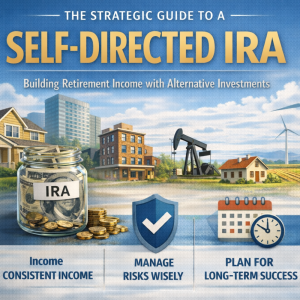

A Self Directed IRA (SDIRA) is a retirement account that expands investment options beyond conventional stocks and funds. For sophisticated investors and accredited individuals, the benefits of a Self Directed IRA can shape long-term wealth strategies.
What Is a Self Directed IRA?
A Self Directed IRA is a tax-advantaged retirement account where the holder directs investments. SDIRAs allow a broader range of assets than traditional IRAs. You choose real estate, private equity, precious metals, and other alternatives while maintaining tax benefits.
How SDIRAs Work
Custodians administer SDIRAs but do not provide investment advice. You decide what assets to hold, ensuring compliance with IRS rules.
Key Differences From Traditional IRAs
Traditional IRAs focus on stocks, bonds, and mutual funds. SDIRAs include those plus alternative assets. This creates flexibility and control.
Core Benefits of Self Directed IRAs
Self Directed IRAs are designed for investors who want more control and broader opportunity sets within a tax-advantaged retirement structure. Unlike standard retirement accounts that limit choices to public securities, SDIRAs allow investors to align retirement capital with personal expertise, alternative strategies, and long-term wealth objectives. The benefits below explain why SDIRAs are increasingly used by sophisticated and accredited investors.
Expanded Investment Flexibility
One of the most significant benefits of a Self Directed IRA is the ability to invest beyond traditional stocks, bonds, and mutual funds. SDIRAs can hold assets such as real estate, private equity, private credit, precious metals, and certain alternative investments. This flexibility allows investors to deploy capital into opportunities they understand deeply rather than relying solely on public markets.
Enhanced Portfolio Diversification
Self Directed IRAs enable diversification across asset classes that often behave differently from public equities. Real assets and private investments may reduce correlation to stock market cycles, which can help smooth long-term portfolio volatility. For retirement planning, this broader diversification can strengthen resilience during market downturns.
Potential for Higher Returns
Alternative assets accessible through SDIRAs may offer higher return potential compared to traditional investments, particularly when sourced through experience or proprietary deal flow. While higher returns are never guaranteed, investors with strong underwriting skills can pursue opportunities unavailable in standard retirement accounts. Over long horizons, this can materially impact retirement outcomes.
Tax Advantages (Roth vs Traditional SDIRA)
SDIRAs retain the core tax benefits of traditional and Roth IRAs. Traditional SDIRAs generally offer tax-deferred growth, while Roth SDIRAs allow for tax-free qualified withdrawals in retirement. The key advantage is that these tax benefits apply to a wider range of investments, not just public securities.
Greater Control and Investment Autonomy
With a Self Directed IRA, the investor makes all investment decisions rather than a brokerage platform or fund manager. This autonomy allows for faster execution, customized strategies, and alignment with personal conviction. For experienced investors, greater control can be a decisive advantage in building a retirement portfolio that reflects both expertise and long-term goals.

Advanced Strategic Benefits For Accredited Investors
Access To Private Placements & Alternative Assets
Accredited investors can use SDIRAs to hold private placements, venture capital, and private credit. These assets often lie outside standard retirement offerings.
Tailored Retirement Planning For High Net Worth
Customized SDIRA strategies allow integration with estate planning and complex wealth structures. This enhances generational planning.
Quantifying SDIRA Benefits With Data
Historical Returns On Alternative Assets
Real estate and private equity have generated outsized risk-adjusted returns in many decades. Integrating these into retirement accounts may augment long-term growth.
Risk Adjusted Performance In Retirement Views
Alternative assets, when properly vetted, can smooth volatility and deliver differentiated exposure.
Balancing Benefits With Responsibilities
Regulatory & Custodial Requirements
SDIRAs must follow strict IRS rules. Prohibited transactions and disqualified persons are defined by IRS guidelines.
Due Diligence And Risk Management
You must assess investments independently. Custodians do not vet deals. This increases responsibility but also preserves control.
Who Should Consider A Self Directed IRA?
Experienced Investors
Those with expertise in niche markets can leverage SDIRA flexibility to pursue higher-conviction investments.
Entrepreneurs & Business Owners
Business owners can use SDIRAs to hold private business interests or industry-specific assets.
Estate Planning Considerations
SDIRAs can be aligned with Roth conversions and generational tax planning.
Actionable Steps To Capture SDIRA Benefits
- Research and select a reputable SDIRA custodian.
- Define asset types that align with your financial strategy.
- Understand tax and regulatory implications with a trusted tax professional.
For perspectives at the intersection of entrepreneurship, capital allocation, and long-term business value creation, visit StephenTwomey.com.
Disclosure: None of the writing on this article or site is financial advice.