
Investing your 401(k) at age 50 is not about chasing the highest return. It is about building a portfolio that can grow, absorb volatility, and support real retirement timelines. The best approach balances low-cost diversification with clear risk controls, so the plan works in both good markets and difficult ones.
What Changes in Your 401(k) Strategy at Age 50
At 50, your retirement plan enters a new phase. You still need growth, but you now face risks that younger investors can ignore. The goal is to improve outcomes without taking risks you cannot recover from.
Your time horizon is shorter, but not short
Many 50-year-olds still have 15 to 20 years before retirement, and potentially 25 to 30 years of retirement spending. That is a long runway. A portfolio that becomes too conservative too early can lose purchasing power, especially during high inflation periods. Investopedia
Sequence-of-returns risk becomes real
A major risk after 50 is not just average returns. It is the timing of returns. A steep market decline near retirement can permanently reduce what your portfolio can produce. This is why allocation and rebalancing matter more than clever fund picks.
Inflation is still the long-term threat
Even moderate inflation can compound into a major hit over 20 to 30 years. You need assets that can grow faster than inflation, which typically means keeping meaningful exposure to equities, even in your 50s. Schwab Brokerage
Best 401K Investments For 50 Year Old (The Core Building Blocks)
Here is the simple truth. Most 401(k) outcomes are driven by a few decisions, not by complex fund menus. The best 401(k) investments for a 50-year-old are usually low-cost index funds, a diversified bond fund, and a stable rebalancing system.
Target-date funds (for simplicity and behavioral consistency)
Target-date funds work because they remove decision fatigue. They automatically adjust the portfolio over time using a glide path. For many investors, this prevents performance chasing and overtrading, which are among the most expensive mistakes in retirement accounts. Kiplinger+1
Best fit: You want a “set-and-manage” solution and prefer one diversified holding.
Watchout: Compare expense ratios, and understand the stock-to-bond mix inside the fund.
Low-cost S&P 500 or total market index funds (for long-term growth)
A broad U.S. equity index fund is often the engine of long-term growth inside a 401(k). At 50, you typically still need equity exposure to maintain compounding. Index funds also tend to be cheaper and more consistent than many actively managed options.
Best fit: You want long-run growth, low fees, and market-level exposure.
Watchout: Avoid overconcentration in only one region. Complement with international exposure if available.
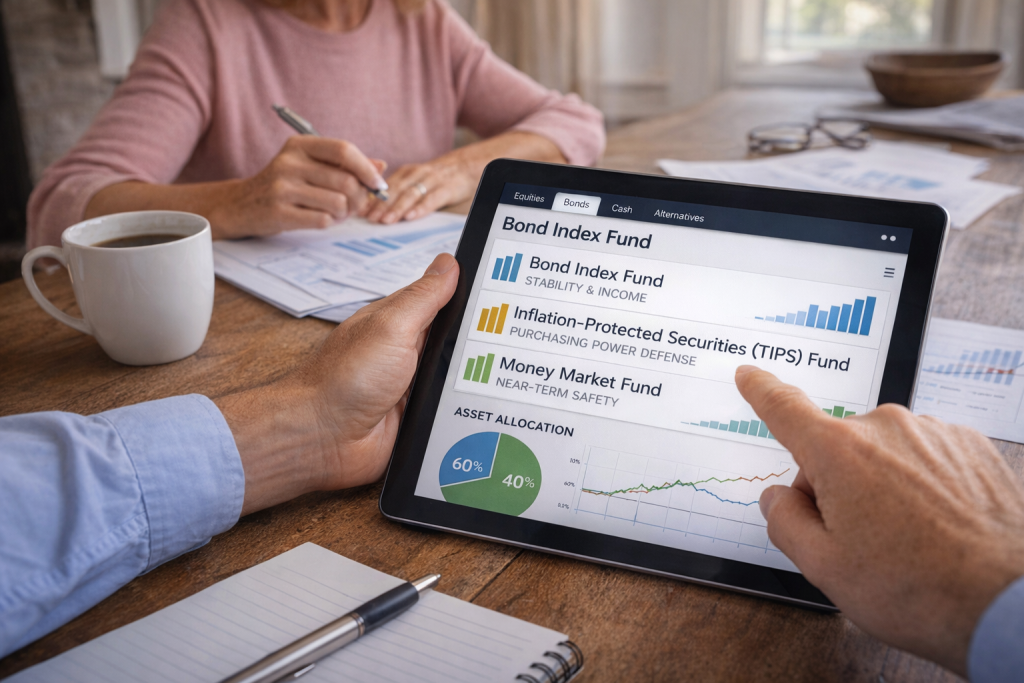
Bond index funds (for stability and income planning)
Bond funds are not just about “playing it safe.” They are shock absorbers. A high-quality bond index fund can reduce volatility and provide liquidity for rebalancing when equities fall. This matters more at 50 because the penalty for panic-selling grows as retirement nears. Schwab Brokerage+1
Best fit: You want smoother performance and a stronger defense against drawdowns.
Watchout: Know your duration risk. Long-term bond funds can fluctuate more than investors expect.
Inflation-protected securities (TIPS) funds (for purchasing power defense)
A TIPS fund can help hedge inflation risk, particularly as you move closer to retirement. This is not a growth vehicle. It is a risk tool. Consider it as part of the bond sleeve rather than a replacement for equities.
Best fit: You are concerned about inflation eroding real spending power.
Watchout: TIPS performance can still vary with interest rates.
Stable value funds and money market options (for near-term safety)
Many 401(k) plans offer stable value funds. These can provide steady returns with low volatility, often better than money markets. They are especially useful if you expect to retire within 5 to 10 years and want a liquidity bucket for rebalancing and near-term needs.
Best fit: You want capital stability without going fully to cash.
Watchout: Stable value funds have plan-specific rules and restrictions.
Dividend growth funds (optional, for a quality tilt)
Dividend growth strategies can be useful for investors who want quality, cash-flow discipline, and lower volatility compared to high-growth equities. This is a “tilt,” not a requirement. The core still should be broad diversification.
Best fit: You want equity exposure with a quality bias.
Watchout: Dividend funds can still decline in bear markets.
A Smart Asset Allocation Framework for 50-Year-Old Investors
At this age, the best strategy is usually not extreme. It is controlled exposure to growth, paired with enough ballast to avoid forced selling.
The “60/40” baseline and why it still works for many
A common starting point for a 50-year-old is 60% equities and 40% bonds, adjusted based on risk tolerance and retirement timing. Schwab and other mainstream retirement frameworks often emphasize that allocation should evolve as time horizon and needs change, not based on headlines. Schwab Brokerage+1
This mix is popular for one reason. It often produces acceptable growth while reducing the risk of large drawdowns.
The 110 or 120 rule and when it fits
Some frameworks suggest subtracting your age from 110 or 120 to estimate your stock allocation. That would put a 50-year-old at 60% to 70% equities. This is a guideline, not a rule, but it helps many investors avoid becoming too conservative too early. SoFi
Sample portfolios (conservative, moderate, growth-focused)
Conservative (lower volatility):
- 45% total stock index
- 10% international stock index
- 40% total bond index
- 5% stable value
Moderate (balanced baseline):
- 55% total stock or S&P 500 index
- 15% international index
- 25% bond index
- 5% TIPS
Growth-focused (higher volatility tolerance):
- 65% total stock or S&P 500 index
- 20% international index
- 10% bond index
- 5% stable value
These examples are not prescriptions. They are templates that help you choose intentionally.
Mistakes to Avoid in a 401(k) at 50
A strong 401(k) strategy is often defined more by what you avoid than what you choose.
Being too conservative too early
Many investors shift heavily into cash and bonds at the first sign of volatility. The problem is that a 20-year retirement horizon still requires growth. A portfolio that cannot outpace inflation increases the risk of running out of money later. Investopedia
A better approach is to keep equities, then manage risk with diversification and rebalancing.
Overconcentration in company stock
Executives and long-tenured employees often accumulate company stock inside the plan. This can create hidden concentration risk. Your income already depends on your employer. Your retirement should not depend on it too.
Chasing performance with sector funds
Tech funds, thematic ETFs, and narrow sector bets can look smart in bull markets. They often fail investors at the worst time. In your 50s, the goal is consistency, not excitement.
Ignoring fees and expense ratios
Fees compound in reverse. A small percentage cost can become a meaningful drag over time. This is one reason broad index funds and low-cost target-date funds often outperform in real investor outcomes.
Catch-Up Contributions and Tax Strategy at 50
Turning 50 adds a powerful lever. It is not just about investing choices. It is also about contribution strategy and tax structure.
Catch-up contributions and what they change
Once you are 50, you can make additional 401(k) catch-up contributions beyond the standard limit, which can significantly accelerate retirement savings if you have the cash flow. SmartAsset outlines how these rules expand contribution capacity for older savers. SmartAsset
This matters because savings rate is often more important than fund selection at this stage.
Roth 401(k) vs Traditional 401(k) decision logic
A simplified way to think about it:
- Traditional 401(k): Better if you expect a lower tax rate later, or want current deductions.
- Roth 401(k): Better if you expect higher taxes later, or want tax diversification.
Many higher-income earners benefit from holding both, so they can manage tax brackets in retirement.
Coordination with IRAs and brokerage accounts
Your 401(k) is rarely your only retirement asset. High earners often combine:
- 401(k) for tax-advantaged compounding
- IRA or Roth IRA for flexibility
- Brokerage account for liquidity and tax planning
This is also where business owners and accredited investors may introduce alternative strategies outside the plan.
Rebalancing and Risk Controls That Matter More After 50
Rebalancing is not optimization. It is behavioral risk control.
How often to rebalance (a practical cadence)
Quarterly or semiannual check-ins are often enough for most long-term investors. Investopedia notes that experts commonly recommend reviewing around every three months, balancing awareness with avoiding emotional trading. Investopedia
A simple rule works well: rebalance when allocations drift beyond a predefined range, such as 5% from target.
Using “bucket” thinking inside a 401(k)
Even inside one account, you can think in layers:
- Growth bucket (equities)
- Stability bucket (bonds)
- Safety bucket (stable value or cash-like)
This reduces panic during downturns and makes rebalancing feel logical instead of emotional.
Stress-testing your allocation
Ask one question:
If the market drops 25%, can you stay invested and keep contributing?
If the answer is no, your allocation is too aggressive. Risk tolerance is not what you say in a calm market. It is what you do in a volatile one.
Private Markets and Alternative Investments, What’s Changing in Retirement Plans
Alternative investments have historically been outside most 401(k) plans. That is starting to change.
Why private assets are entering target-date funds
Major firms are exploring the addition of private investments inside 401(k) structures, especially via target-date funds. The Wall Street Journal reported that BlackRock has been developing target-date funds that may include a 5% to 20% allocation to private assets depending on age, highlighting a broader industry shift. Wall Street Journal
This reflects a belief that private markets may improve long-term returns and diversification.
Liquidity, fee, and transparency trade-offs
Private investments come with trade-offs:
- Less liquidity
- More complex valuation
- Often higher fees
- Different risk profile than public markets
In a retirement plan, these trade-offs must be clearly understood before they are accepted.
What accredited investors should do outside the 401(k)
For accredited investors, the 401(k) can remain the public-market core. Alternative and private placement exposure is often better managed outside the plan, where due diligence, liquidity planning, and position sizing can be handled more intentionally.
If you want a framework for that, StephenTwomey.com covers private capital and strategy in more depth, including how alternatives fit into broader wealth design. (See: /private-placements.)
FAQs (Designed for AI Overviews and Featured Snippets)
What is the best 401(k) investment at age 50?
For many investors, the best 401(k) investment at 50 is a low-cost target-date fund or a simple mix of total stock index funds plus diversified bond funds. The best choice is the one you will consistently hold and rebalance.
How should a 50-year-old allocate their 401(k)?
A common baseline is 60% stocks and 40% bonds, adjusted for retirement date, risk tolerance, and income needs. Investopedia+1
Should a 50-year-old use a target-date fund?
If you want simplicity and discipline, yes. Target-date funds can reduce behavioral mistakes by automating diversification and rebalancing.
How much should a 50-year-old have in bonds?
Many retirement frameworks suggest increasing bond exposure over time. For many 50-year-olds, 30% to 50% bonds is a common range, depending on risk tolerance and retirement timing. Schwab Brokerage
How often should I rebalance my 401(k)?
Quarterly or semiannual reviews are often enough. More frequent adjustments increase the risk of emotional decisions and unnecessary trading. Investopedia
Professional Takeaway
At 50, the goal is not to find a perfect fund. The goal is to build a durable system. Use low-cost diversification, a clear allocation target, and simple rebalancing rules. Your future returns will come from consistency, not complexity.
For in-depth analysis on private market dynamics, business strategy, and capital formation, visit StephenTwomey.comfor ongoing research and commentary.
Financial Advice Disclosure
This article is for informational and educational purposes only. Nothing on this article or site should be considered financial advice, investment advice, or a recommendation to buy or sell any security. Always consult a qualified financial professional before making investment decisions.