
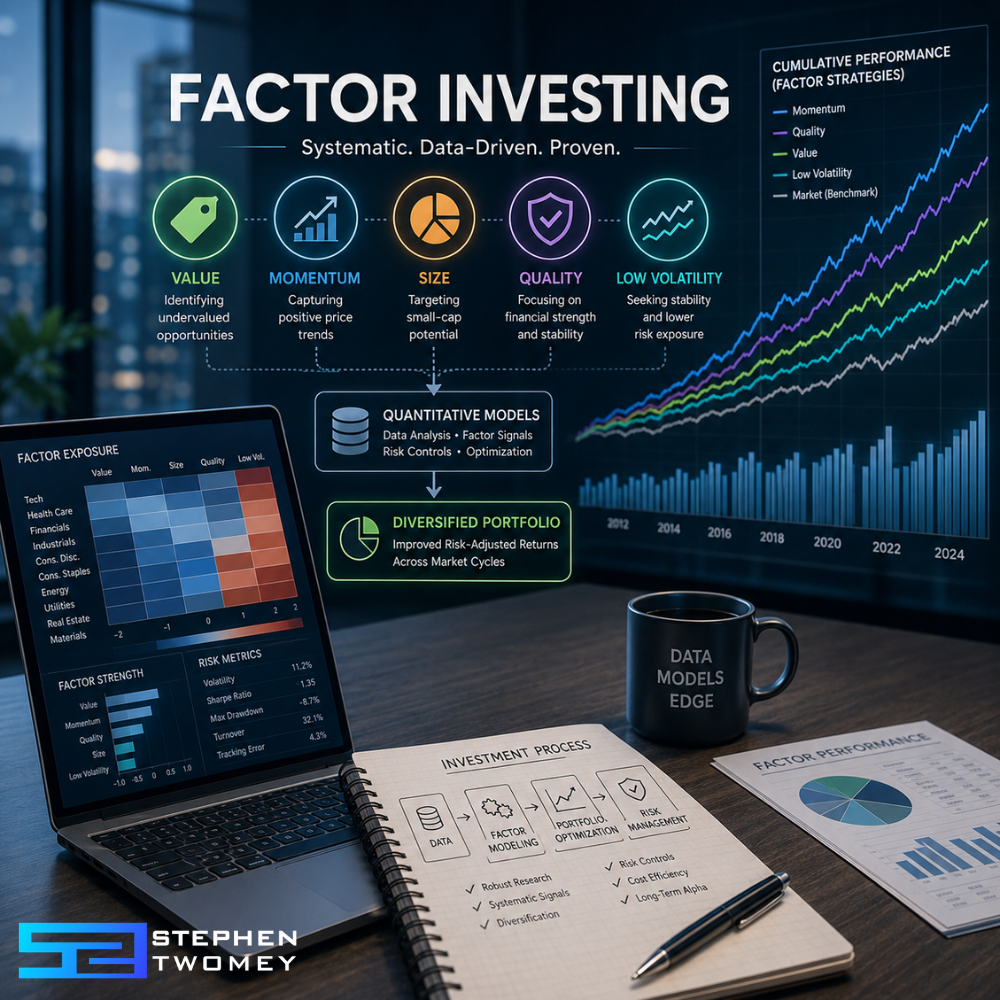
What Is Factor Investing?
Factor investing is an investment strategy that targets specific drivers of return, known as “factors,” which have historically explained why certain assets outperform others over long periods of time.
Rather than selecting investments based purely on intuition or traditional stock picking, factor investing uses systematic and data-driven methods to identify securities with characteristics associated with higher expected returns.
In modern finance, factors are measurable attributes that influence performance across large groups of assets.
Examples include:
- Value
- Momentum
- Size
- Quality
- Volatility
Factor investing has become one of the most important foundations of modern quantitative trading and institutional portfolio management.
Today, factor-based strategies are used by:
- Quant hedge funds
- Pension funds
- Asset managers
- Smart beta ETFs
- Institutional investors
The growth of factor investing accelerated significantly after decades of academic research demonstrated that certain investment characteristics consistently generated excess returns over time.
How Factor Investing Works
Factor investing works by systematically identifying securities that exhibit specific characteristics associated with historical outperformance.
Instead of attempting to predict individual stock movements, factor investors build portfolios around broad statistical tendencies.
For example:
- A value strategy buys undervalued stocks
- A momentum strategy buys strong-performing stocks
- A quality strategy buys financially stable companies
Modern factor investing relies heavily on:
- Quantitative models
- Financial data analysis
- Portfolio optimization systems
- Algorithmic screening
This systematic approach separates factor investing from traditional discretionary investing.
Core Factors in Quant Investing
Several factors have historically demonstrated persistent return premiums across global markets.
These factors form the backbone of many institutional quant trading strategies.
Value
Value investing focuses on buying undervalued assets relative to fundamentals.
Common valuation metrics include:
- Price-to-earnings ratio (P/E)
- Price-to-book ratio (P/B)
- Free cash flow yield
- Enterprise value metrics
The theory behind value investing is that markets sometimes underprice fundamentally strong companies.
Over time, prices may revert closer to intrinsic value.
Value investing became globally popular through investors such as:
- Benjamin Graham
- Warren Buffett
However, quantitative value investing uses systematic models rather than discretionary stock selection.
Many factor-based hedge funds rank thousands of securities simultaneously using value metrics.
Momentum
Momentum investing focuses on buying assets that are already trending upward.
The principle behind momentum is that strong-performing assets often continue outperforming for extended periods.
Momentum systems typically evaluate:
- Relative strength
- Trend persistence
- Price acceleration
- Moving average signals
Momentum is one of the most widely used factors in modern finance and plays a major role in advanced momentum vs mean reversion strategies.
Institutional quant funds often combine momentum with other factors to improve diversification and reduce risk.
Size
The size factor is based on the historical observation that smaller companies tend to outperform larger companies over long periods.
This is commonly called the “small-cap premium.”
Smaller companies may outperform because they often:
- Grow faster
- Receive less analyst coverage
- Carry higher risk premiums
Quantitative factor models frequently include size exposure as part of broader multi-factor portfolios.
However, the small-cap premium can disappear or weaken during certain market regimes.
Quality
Quality investing focuses on companies with strong financial fundamentals.
Characteristics of high-quality companies may include:
- Strong balance sheets
- Consistent earnings growth
- High return on equity
- Low debt levels
- Stable cash flow generation
Quality investing became especially popular after periods of market volatility because financially stable companies tend to perform more defensively during economic downturns.
Large institutional investors often combine quality with value and momentum within broader quantitative trading systems.
Low Volatility
Low volatility investing targets assets with historically lower price fluctuations.
This factor is based on the observation that lower-volatility stocks have sometimes produced surprisingly strong risk-adjusted returns over time.
Low volatility strategies are commonly used by:
- Pension funds
- Conservative portfolios
- Risk-managed quantitative funds
This factor is particularly attractive during uncertain macroeconomic environments.

How Quant Funds Use Factor Investing
Modern quant funds rarely rely on a single factor.
Instead, they combine multiple factors within sophisticated systematic portfolios.
Multi-Factor Models
Multi-factor investing combines several factors simultaneously to improve diversification and reduce dependence on any one market regime.
A multi-factor portfolio may include:
- Value exposure
- Momentum exposure
- Quality exposure
- Size exposure
The goal is to smooth returns across different economic environments.
For example:
- Momentum may outperform during trending bull markets
- Value may outperform during recovery cycles
- Quality may outperform during recessions
Combining factors can improve long-term risk-adjusted returns.
Many institutional quant trading strategies rely heavily on multi-factor optimization.
Portfolio Optimization
Factor investing is not simply about selecting good securities.
Portfolio construction is equally important.
Quant funds use optimization techniques to:
- Balance factor exposure
- Reduce concentration risk
- Minimize volatility
- Control sector exposure
- Improve Sharpe ratios
Sophisticated optimization systems may also:
- Neutralize unwanted factor exposures
- Reduce transaction costs
- Manage turnover
This process often involves advanced mathematics, machine learning, and large-scale data analysis.
Modern machine learning trading systems increasingly incorporate factor models into predictive frameworks.
Factor Investing vs Traditional Investing
Factor investing differs significantly from traditional discretionary investing.
Systematic vs Discretionary
Traditional investing often relies on:
- Human judgment
- Analyst opinions
- Subjective forecasts
Factor investing relies on:
- Rules-based systems
- Quantitative analysis
- Statistical evidence
This systematic structure reduces emotional decision-making.
Data-Driven vs Emotional
Discretionary investors may react emotionally to:
- Market volatility
- News events
- Fear and greed
Factor investing removes much of this emotional bias by following predefined quantitative rules.
This consistency is one reason institutional investors increasingly favor systematic investment processes.
Scalable Investment Process
Factor models can analyze thousands of securities simultaneously.
This scalability makes factor investing highly attractive for:
- Large hedge funds
- ETFs
- Institutional asset managers
It also aligns naturally with modern algorithmic trading infrastructure.
Risks of Factor Investing
Although factor investing has become extremely popular, it is not risk-free.
Factor Crowding
As more investors allocate capital to factor strategies, certain trades can become overcrowded.
When too many investors chase the same factors:
- Valuations may become stretched
- Future returns may decline
- Volatility may increase during reversals
Crowding has become a major concern in modern quantitative finance.
Changing Market Regimes
Factor performance is cyclical.
Certain factors may underperform for years depending on:
- Interest rates
- Economic conditions
- Market sentiment
- Volatility regimes
For example:
- Value significantly underperformed growth stocks during parts of the 2010s
- Momentum can suffer during sudden market reversals
This cyclicality is why diversification across factors is important.
Model Risk
Factor models are based on historical data.
There is no guarantee historical relationships will persist in the future.
Changes in:
- Market structure
- Technology
- Regulation
- Investor behavior
can weaken factor performance over time.
Why Factor Investing Became So Popular
Factor investing grew rapidly because it combines:
- Academic research
- Systematic execution
- Scalable portfolio management
The rise of:
- ETFs
- quantitative hedge funds
- machine learning systems
- algorithmic trading infrastructure
has accelerated adoption globally.
Today, factor investing forms the foundation of many institutional portfolios.
FAQ: Is Factor Investing Still Effective?
Yes, factor investing remains effective over long time horizons, but performance cycles over time.
Different factors outperform during different economic conditions.
For example:
- Momentum may outperform during strong bull markets
- Value may outperform during recovery periods
- Quality may outperform during recessions
This is why many institutional investors diversify across multiple factors rather than relying on a single strategy.
FAQ: What Is Smart Beta?
Smart beta is a rules-based investment strategy that uses factor investing principles to construct portfolios.
Unlike traditional market-cap-weighted indexes, smart beta portfolios may weight securities based on:
- Value
- Momentum
- Volatility
- Quality
- Dividend yield
Smart beta ETFs have become extremely popular because they combine:
- Passive investing efficiency
- Quantitative factor exposure
Many smart beta products are essentially simplified forms of institutional factor investing.