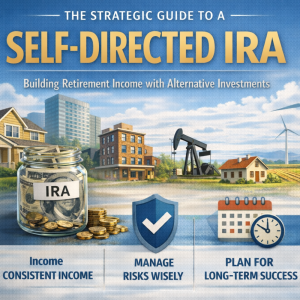

In today’s expanding alternative investment landscape, accredited investors and business leaders seek ways to deploy tax-advantaged capital into private markets. This guide shows how a self-directed IRA can become a powerful vehicle for investing in private placement funds, while highlighting rules, structures, risks and opportunity.
Disclosure: This article is for educational purposes only and does not constitute financial, tax or legal advice.
What is a Self-Directed IRA and Why It Matters
A self-directed IRA (SDIRA) is a retirement account that gives you broad control over investment choices outside of traditional stocks and bonds. Standard IRA custodians typically limit holdings to mutual funds, ETFs and public securities. With an SDIRA you can hold real estate, private equity, debt, private placement funds and other alternative assets.
The market for IRAs in the U.S. now exceeds $11 trillion, and SDIRAs represent one of the fastest growing segments of that market.
For high-net-worth investors and entrepreneurs, an SDIRA offers access, diversification and a strategic layer in a retirement-capital plan.
Private Placement Funds Explained
What qualifies as a private placement (Reg D, Reg A, etc.)
A private placement typically refers to securities offered to a limited number of select investors outside a public offering. These may include limited liability companies (LLCs), limited partnerships (LPs), convertible notes, or private funds structured under Regulation D or Regulation A.
For example, under Reg D 506(b) an issuer may sell to accredited investors without solicitation; under 506(c) solicitation is permitted if all investors are accredited.
How private placements differ from public offerings
Because private placements bypass full SEC registration, they may have less regulatory transparency, longer liquidity horizons and higher risk. But that also means potential access to non-public deals, early-stage growth, or niche asset classes—opportunities often unavailable via standard IRAs.
How to Invest in Private Placement Funds Using a Self-Directed IRA
Eligibility – accredited investor, account types
To invest in many private placements, you must meet the accredited investor definition: e.g., annual income of at least $200,000 ($300,000 for joint), or net worth of $1 million excluding primary residence.
Your retirement account must also be eligible: a Traditional IRA, Roth IRA, SEP, SIMPLE or Solo 401(k) may be used—so long as the custodian allows private-asset holdings.
Account setup and rollover/transfer steps
- Choose an SDIRA custodian who permits private placements.
- Open the SDIRA and fund it via contribution or rollover from an existing IRA or 401(k).
- Within the account, select the private placement fund or issuer. Submit investment authorization to the custodian.
Investment execution: process, custodian, documentation
Funds flow from the SDIRA custodian to the issuer under the IRA’s name (for example: “Custodian FBO [Owner] IRA #”). The issuer provides a Private Placement Memorandum (PPM), subscription agreement and investor certification.
If your SDIRA uses a “checkbook control” LLC structure, the IRA owns an LLC, and the LLC writes checks for investment. This can streamline execution but adds compliance complexity.

Key Compliance, Tax & Structural Considerations
UBTI/UBTI tax issues for pass-throughs
If your SDIRA invests in an entity that generates unrelated business taxable income (UBTI) or unrelated debt-financed income (UDFI), the IRA may owe tax despite being tax-advantaged.
For example, if the private placement operates as an LLC/partnership and uses debt financing, the IRA owner may incur UBTI tax.
Prohibited transactions and disqualified persons
Under IRC §408 & §4975, your IRA must avoid self-dealing, transactions with “disqualified persons” (you, your spouse, certain relatives, business entities). Violations can void tax-advantaged status.
Valuation and liquidity challenges
Private placements often lack secondary markets. Holding periods may span 3-10 years.
Pricing and annual valuation become more complex when assets are illiquid. Ensure your SDIRA custodian has governance in place.
Due Diligence and Risk Management for Alternative IRA Investments
Sponsor track record, offering documents (PPM), exit strategy
Successful private placement investing via an SDIRA starts with rigorous due diligence. Review the fund sponsor’s track record, business plan, use-of-proceeds, exit strategy, fees, lock-up and governance.
Request the PPM, audited financials, subscription documents, operating agreements.
Diversification and risk mitigation in alternative retirement accounts
While private placements can offer higher growth potential, they carry higher risk. Structure exposure as a portion of the SDIRA, align with your overall wealth strategy, and avoid concentrating too heavily in a single private vehicle. As one advisor noted: “If you put all your eggs in one illiquid deal, you may jeopardize your retirement timeline.”
Case Examples & Strategic Insights for Accredited Investors
Real-life examples of IRA-based private placements
One real estate syndication raised capital through SDIRAs, offering residential development access to retirement investors. Another venture-capital oriented fund accepted SDIRA rollovers into its Reg D entity.
Positioning within a broader wealth strategy
For entrepreneurs and marketing professionals, consider using your SDIRA to invest in niche sectors you understand—such as private tech funds or experiential real estate—that align with your expertise. Pair that with traditional portfolios for balance.
Using a self-directed IRA for private placements is not about abandoning stocks and bonds—it’s about enhancing your portfolio with alternative engines of growth, deployed smartly.
Action Plan: Steps for Marketing Professionals, Entrepreneurs & Business Leaders
Integrating SDIRA + private placement approach into your portfolio
- Confirm your accredited-investor status (or prepare to meet criteria).
- Choose an SDIRA custodian experienced with private placements.
- Identify 1–2 private placement funds that align with your sector expertise and retirement timeline.
- Allocate a defined portion of your SDIRA to alternative assets—e.g., 10-20%—not your entire retirement balance.
- Establish a governance process: document due diligence, monitor performance, maintain records.
Working with advisors, structuring strategy, next-steps
Work with a tax advisor or attorney familiar with SDIRAs and alternative assets. Request a legal review of PPMs and ensure compliance with prohibited-transaction rules. Schedule an annual check-in to assess asset performance, liquidity risks and tax implications.
Summary & Professional Takeaway
Summary of key points
- A self-directed IRA enables accredited investors to use retirement capital in private placement funds.
- Private placements inside an SDIRA offer access, diversification and potential growth—but carry higher complexity, illiquidity and regulatory burden.
- Success rests on strong due diligence, compliance oversight, strategic allocation and alignment with your broader wealth plan.
Final checklist
- Verify custodian allows private placement investing.
- Confirm accreditation status and investment timeline.
- Review PPM, offering structure, fees, exit strategy.
- Assess UBTI, prohibited transaction risk, liquidity horizon.
- Allocate responsibly and monitor periodically.
For perspectives at the intersection of entrepreneurship, capital allocation, and long-term business value creation, visit StephenTwomey.com.