
Investing at 50 is a strategic reset. You are no longer investing for a vague future, you are investing on a clock. The right approach blends growth, protection, tax efficiency, and optionality, without falling into the common trap of becoming too conservative too early.
This guide breaks down the best investments for 50-year-olds through the lens of portfolio design, retirement math, and modern wealth strategy, including where alternative investments and private placements may fit for accredited investors.
Disclosure: This article is for educational purposes only and does not provide financial, legal, or tax advice. Investing involves risk, including loss of principal. Consider speaking with a licensed professional before making investment decisions.
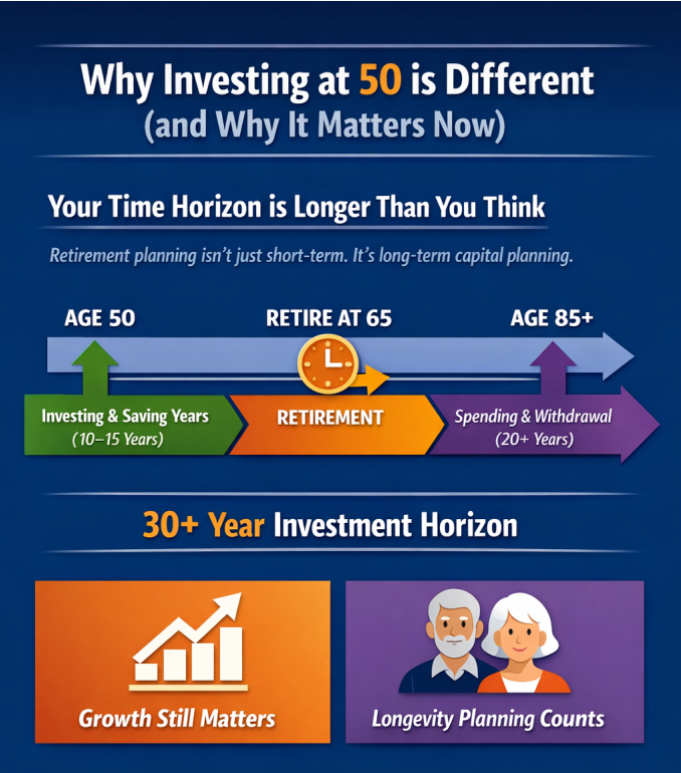
Why Investing at 50 is Different (and Why It Matters Now)
Your time horizon is longer than you think
Many 50-year-olds plan as if retirement is 10–15 years away. In reality, the investment horizon often stretches 30 years or more when you include retirement spending years. That means growth assets still matter, even if retirement feels close.
A 50-year-old who retires at 65 may still need their portfolio working at age 85. That is not a short-term allocation problem. It is a long-duration capital planning problem.
The real risk is inflation, not volatility
Volatility feels like risk because you can see it. Inflation is worse because it quietly taxes your future lifestyle. A portfolio that is too heavy in cash and low-yield bonds can look stable while it loses purchasing power.
This matters now because many retirees and near-retirees have drifted toward cash-heavy allocations, which research suggests can backfire long term. Investopedia+1
The “retirement red zone” and sequence risk
The decade before retirement and the first decade of retirement is often called the “red zone.” It is when poor returns can permanently damage a plan if withdrawals begin during a down market.
This is why a 50-year-old needs both growth and a stability plan. You want upside participation, but you also want time and liquidity when markets are down.
Start With the Highest-Impact Moves
Maximize employer match and catch-up contributions
Before debating stock funds versus bonds, lock in the highest return available: employer match. Then build around it with catch-up contributions that become available starting at age 50. Top retirement-focused guides consistently prioritize this step because it has immediate compounding impact. NerdWallet+1
Use tax-advantaged accounts before taxable investing
In your 50s, tax efficiency often becomes the difference between “on track” and “behind.” Prioritize accounts that reduce taxes now, reduce taxes later, or both:
- 401(k), 403(b), Solo 401(k)
- Traditional IRA
- Roth IRA (when eligibility and strategy make sense)
- HSA (if eligible, often underused as a retirement asset)
Build a 12–24 month liquidity buffer
A liquidity buffer reduces sequence risk. It also reduces the odds that you sell growth assets during a downturn. Many investors treat cash as a drag. In retirement planning, cash is a volatility-management tool.
The Core Portfolio: What Most 50-Year-Olds Should Own
A strong “base portfolio” at 50 is built from three pillars: growth, stability, and liquidity.
Stocks for growth and longevity risk protection
Equities remain the primary long-term growth engine. Even conservative retirement research often supports meaningful equity allocation in the 50s to fight inflation and fund decades of spending.
The key is diversification. Avoid a portfolio that depends on one sector, one country, or one stock concentration.
Bonds for stability and income
High-quality bonds reduce volatility and can provide predictable income. They also act as dry powder for rebalancing during equity drawdowns.
Focus on the bond role in the portfolio, not the bond “story.” Bonds exist to stabilize the plan, not to win performance battles.
Cash for optionality
Cash is not an investment strategy, but it is a planning asset. Cash gives you options. It gives you time. It reduces forced selling.
The mistake is treating cash as a long-term solution. Research highlights that many near-retirees hold far too much cash, which increases inflation risk. Investopedia+1
Best Investments for 50 Year Olds (By Category)
Below are widely used investment categories that consistently appear in top guides, framed here with a portfolio-design approach rather than a shopping list. NerdWallet+2SmartAsset+2
Broad-market index funds and ETFs
For most investors, index funds and ETFs offer:
- low cost
- high diversification
- easy rebalancing
- strong long-run performance relative to many active strategies
For business owners and high earners, this can be the simplest “core equity engine” while more specialized strategies are layered on top.
Practical example: A 50-year-old entrepreneur uses total market and international ETFs as the foundation, then adds alternatives for non-correlated return streams.
Dividend growth stocks (not just “high yield”)
Dividend growth strategies can support income planning, but “high dividend yield” is not automatically safe. Investors often chase yield, then discover concentration risk or business fragility.
A cleaner approach:
- prioritize quality companies
- look for dividend growth consistency
- avoid treating dividends as a substitute for bonds
Treasury bonds, TIPS, and bond ladders
Treasuries remain a core stability asset. A ladder approach can also support future spending needs.
TIPS (Treasury Inflation-Protected Securities) add explicit inflation linkage, which can be valuable for investors building retirement income frameworks.
Target-date and balanced funds
For simplicity seekers, target-date funds can provide a professionally managed glide path. Some investors dislike “one-size-fits-all” allocations, but they can outperform poorly managed DIY portfolios.
Morningstar’s portfolio research and model examples are useful references when comparing balanced frameworks. Morningstar
High-yield cash, CDs, and short-term Treasuries
Short-term instruments can be useful for liquidity and near-term spending. They should be treated as the liquidity sleeve, not the growth sleeve.
Use these as:
- emergency reserves
- down-payment or near-term expense planning
- retirement red-zone cash buffer
Alternative Investments and Private Placements (For Accredited Investors)
Traditional portfolios are built on public stocks and bonds. For accredited investors, alternatives can add diversification and return drivers that behave differently than public markets.
That said, alternatives introduce three risks that matter more at 50:
liquidity, leverage, and fees.
If those are not managed, alternatives can add complexity without improving outcomes.
Private credit and direct lending
Private credit often targets income-driven returns with less public market volatility. It can be attractive for investors who want cash-flow characteristics, especially when public bonds are volatile.
Key diligence questions:
- Is the structure senior secured?
- What is default history?
- How is underwriting done?
- What happens in a recession?
Real estate syndications vs REITs
Real estate is a common alternative allocation, but “real estate” is not a single asset class. The risk profile depends on:
- leverage levels
- property type
- location fundamentals
- sponsor quality
- cash-flow durability
Syndications can offer tax advantages and operational control, but liquidity is limited. REITs are liquid but correlate more with public markets.
Private equity secondaries and growth capital
Private equity can drive long-term returns, but it often comes with long lockups. Secondaries strategies can reduce the “blind pool” effect and shorten duration.
At 50, private equity is best used when:
- liquidity needs are already covered
- the investor understands time horizons
- the portfolio can tolerate long drawdowns
Interval funds and semi-liquid structures
Interval funds offer periodic liquidity and alternative exposure. They can fit investors who want alternatives with a more accessible structure, but terms and fees must be understood clearly.
Risk controls, fees, and liquidity reality checks
This is the core truth:
Alternative investments can improve diversification, but only when liquidity and fees are treated as first-order risks.
At 50, your portfolio needs flexibility. Do not over-allocate to locked strategies unless your liquidity plan is already solved.
Tax Strategy in Your 50s (Where Most Portfolios Underperform)
Investment returns are only half the story. Net returns after taxes are what fund retirement.
Roth vs Traditional decisions
The correct decision depends on future tax rates, income trajectory, and retirement timing. Many investors default to the same contribution type for decades, then realize they created a future tax problem.
A good framework:
- Traditional accounts reduce taxable income today
- Roth accounts reduce tax exposure later
- Blended strategies can create better flexibility
Asset location strategy (what goes where)
Where you place assets matters:
- tax-inefficient income assets often fit better in tax-advantaged accounts
- long-term growth assets can benefit from taxable capital gains treatment
- alternatives may create K-1 or complex tax reporting
Tax-loss harvesting and charitable tools
Investors with taxable portfolios can use tax-loss harvesting to reduce taxes while maintaining exposure. Charitable tools, such as donor-advised funds, can also create significant tax efficiency for high-income years.
Common Mistakes to Avoid at 50
Becoming too conservative too early
Some investors shift heavily into cash and bonds to avoid volatility. Research and retirement analysis frequently show this can increase long-term failure risk because inflation erodes purchasing power. Investopedia+1
Chasing yield without understanding risk
High yield is often a signal, not a gift. Yield can come from:
- leverage
- credit risk
- concentration
- weak business fundamentals
Income planning needs durability more than headline yield.
Ignoring healthcare and long-term care planning
Healthcare is one of the largest unknowns in retirement. Your investment strategy should account for:
- insurance costs
- long-term care scenarios
- unexpected health events
- out-of-pocket volatility
This is where liquidity planning and conservative sleeves matter most.
A Practical Allocation Framework (With Example Portfolios)
These examples are not personalized advice. They are reference models that show how investors often structure the 50s decade.
Conservative example (40/50/10)
- 40% diversified equities
- 50% high-quality bonds
- 10% cash
- Designed for investors with low risk tolerance or near-term retirement goals.
Balanced example (60/35/5)
- 60% diversified equities
- 35% high-quality bonds
- 5% cash
- This allocation is frequently referenced in professional retirement planning for investors in their 50s who need both growth and stability. Investopedia
Growth-focused example (70/25/5)
- 70% diversified equities
- 25% bonds
- 5% cash
- This model is more common when retirement is later, or when income is strong and consistent.
Where alternatives can fit
A common range for accredited investors is 5% to 20% in alternatives, depending on liquidity needs and experience. This allocation can include private credit, real estate, or structured alternatives.
The key rule: alternatives should diversify the portfolio, not complicate it.
Action Checklist: Your Next 30 Days
Quick audit steps
- Confirm your savings rate and catch-up contribution usage
- Document your target retirement spending range
- Stress test your portfolio for a 2008-style drawdown
- Identify concentration risk in stocks, real estate, or business exposure
- Build a liquidity plan for the next 12–24 months
Questions to ask your advisor
- How does my portfolio manage inflation risk?
- What is my withdrawal strategy in down markets?
- Where are taxes likely to rise for me?
- How much liquidity do I need before I consider alternatives?
- How does this portfolio behave under stress scenarios?
What to document and track
Track:
- asset allocation
- fees and expense ratios
- tax exposure by account type
- liquidity and lockups
- rebalancing thresholds
Even a simple dashboard improves decision-making.
Professional Takeaway
At 50, investing becomes less about finding the perfect product and more about building a resilient system. Your strategy should prioritize tax efficiency, diversification, and a clear liquidity plan. Growth still matters, but growth must be structured.
If you want a short rule to remember:
“At 50, the biggest risk is not volatility. It is running out of purchasing power before you run out of years.”
For more insights on business development, capital growth strategies, and the evolving landscape of private markets, visit StephenTwomey.com — where strategy meets execution.