
What Is Quantitative Trading?
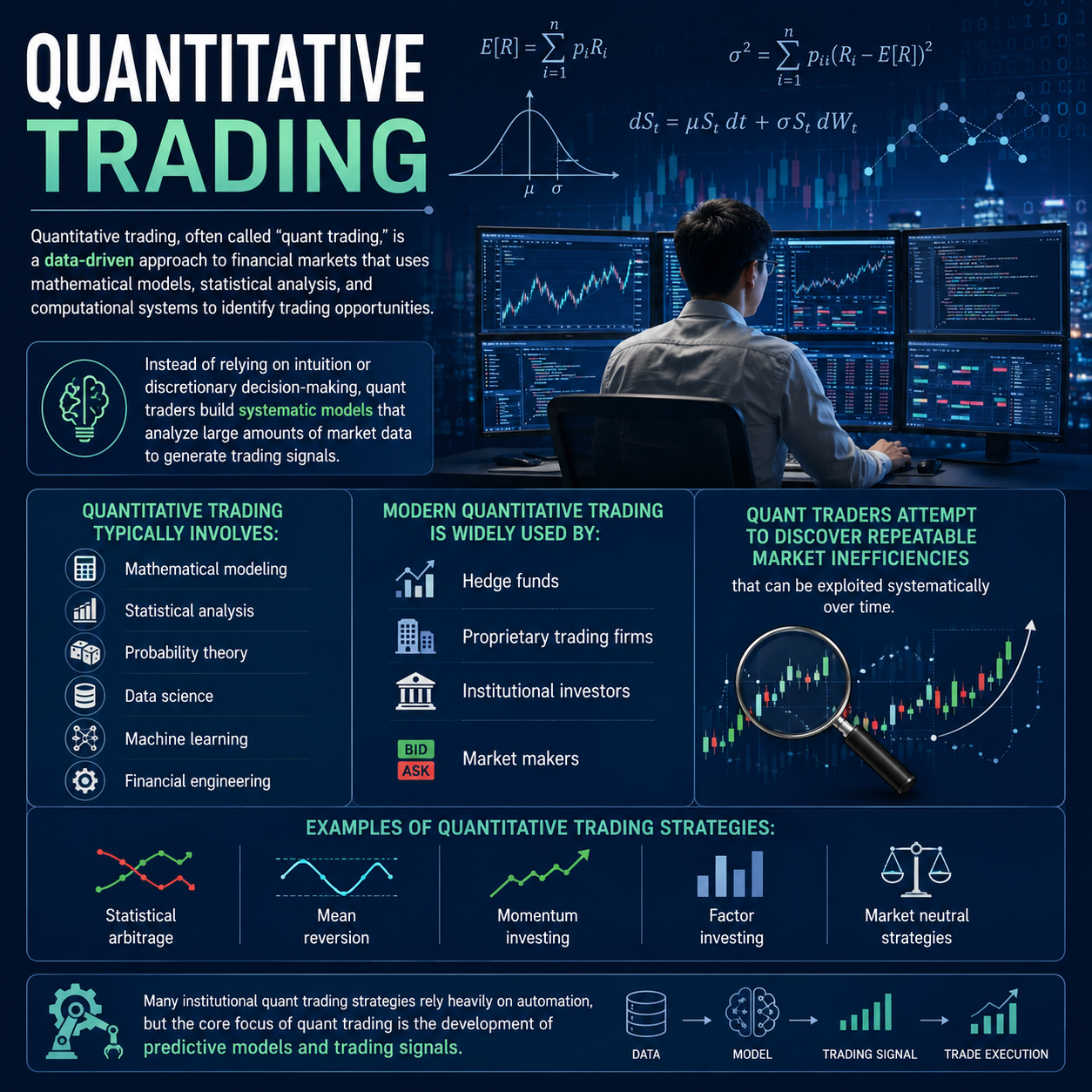
Quantitative trading, often called “quant trading,” is a data-driven approach to financial markets that uses mathematical models, statistical analysis, and computational systems to identify trading opportunities.
Instead of relying on intuition or discretionary decision-making, quant traders build systematic models that analyze large amounts of market data to generate trading signals.
Quantitative trading typically involves:
- Mathematical modeling
- Statistical analysis
- Probability theory
- Data science
- Machine learning
- Financial engineering
Modern quantitative trading is widely used by:
- Hedge funds
- Proprietary trading firms
- Institutional investors
- Market makers
Quant traders attempt to discover repeatable market inefficiencies that can be exploited systematically over time.
Examples of quantitative trading strategies include:
- Statistical arbitrage
- Mean reversion
- Momentum investing
- Factor investing
- Market neutral strategies
Many institutional quant trading strategies rely heavily on automation, but the core focus of quant trading is the development of predictive models and trading signals.
What Is Algorithmic Trading?
Algorithmic trading, commonly called “algo trading,” focuses on using computer programs to automatically execute trades according to predefined rules.
The primary goals of algorithmic trading are:
- Speed
- Efficiency
- Precision
- Reduced human error
Algorithmic trading systems can execute trades automatically based on:
- Price movements
- Technical indicators
- Timing conditions
- Volume thresholds
- Quantitative signals
Unlike quant trading, which emphasizes model development and statistical analysis, algorithmic trading is primarily concerned with execution infrastructure and automation.
Modern algorithmic trading systems are capable of:
- Executing thousands of trades per second
- Managing large portfolios automatically
- Reducing transaction costs
- Optimizing order execution
Algorithmic trading is used across:
- High-frequency trading firms
- Hedge funds
- Banks
- Institutional trading desks
- Retail trading platforms
Today, nearly all institutional trading involves some level of algorithmic execution.
Key Differences Between Quant Trading and Algorithmic Trading
Although the terms are often used interchangeably, quant trading and algorithmic trading are not the same thing.
Quant trading focuses on:
- Research
- Modeling
- Statistical edge generation
Algorithmic trading focuses on:
- Automation
- Trade execution
- Infrastructure
Understanding this distinction is important because many trading systems combine both disciplines.
Strategy vs Execution
The easiest way to understand the difference is:
- Quant trading = strategy generation
- Algorithmic trading = strategy execution
Quant traders attempt to answer:
- What should we trade?
- Why should this edge exist?
- What statistical evidence supports the strategy?
Algorithmic traders attempt to answer:
- How should trades be executed?
- How can execution costs be minimized?
- How can systems run efficiently at scale?
For example:
- A quant model may identify a momentum signal
- An algorithmic execution engine automatically places the trade
This relationship is central to modern statistical arbitrage strategies and institutional trading systems.
Skill Sets
Quant trading and algorithmic trading require different technical skills.
Quant Trading Skills
Quant traders often specialize in:
- Mathematics
- Statistics
- Data science
- Financial modeling
- Machine learning
- Probability theory
Common educational backgrounds include:
- Physics
- Mathematics
- Computer science
- Engineering
- Quantitative finance
Quant traders spend much of their time:
- Researching datasets
- Building predictive models
- Backtesting strategies
- Analyzing market behavior
Algorithmic Trading Skills
Algorithmic traders focus more heavily on:
- Software engineering
- Trading infrastructure
- Execution systems
- Latency optimization
- Database systems
- Networking
Algorithmic trading engineers often work on:
- Order management systems
- Real-time data pipelines
- Execution optimization
- Low-latency systems
High-frequency trading firms place enormous emphasis on infrastructure speed because microseconds can impact profitability.
Speed vs Prediction
Quant trading primarily focuses on prediction and edge discovery.
Algorithmic trading focuses on:
- Efficient execution
- Minimizing slippage
- Managing transaction costs
- Reducing latency
This distinction becomes especially important in high-frequency trading environments.
Research vs Infrastructure
Quant teams are usually research-oriented.
Their responsibilities include:
- Strategy development
- Signal generation
- Portfolio optimization
- Risk modeling
Algorithmic trading teams are infrastructure-oriented.
Their responsibilities include:
- Building execution engines
- Managing trading systems
- Optimizing market connectivity
- Maintaining reliability
At large hedge funds, these functions often operate as separate teams working closely together.
How Quant Trading and Algorithmic Trading Work Together
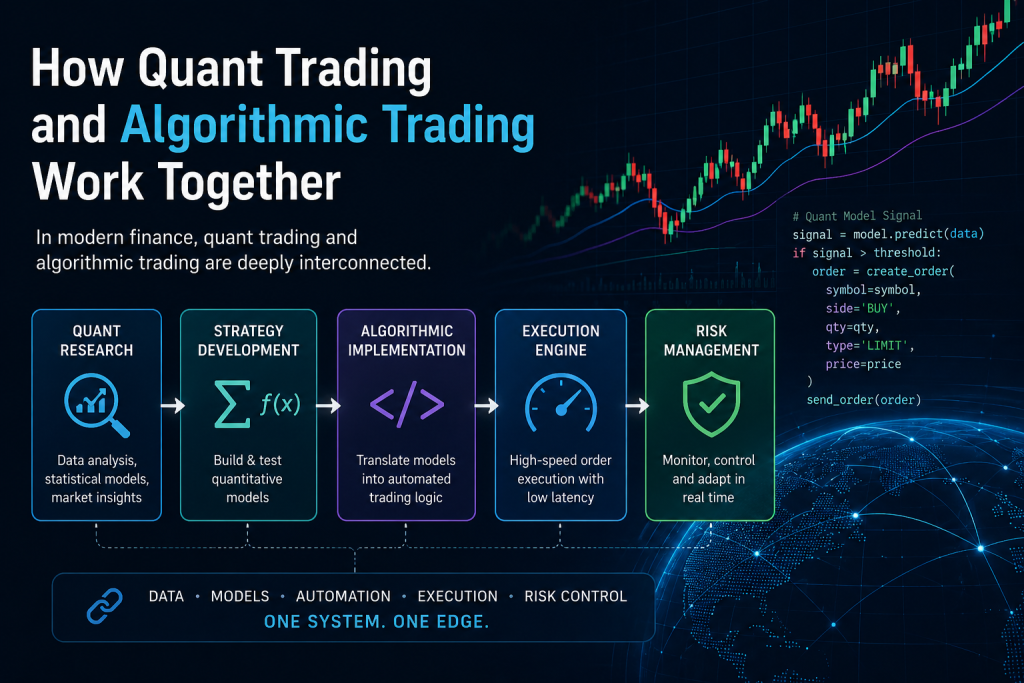
In modern finance, quant trading and algorithmic trading are deeply interconnected.
Most institutional systems combine:
- Quantitative models for signal generation
- Algorithmic systems for execution
For example:
- A quant model identifies a statistical arbitrage opportunity
- An execution algorithm automatically routes orders
- Risk systems manage exposure in real time
This combination allows firms to:
- Scale trading operations
- Reduce emotional decision-making
- Improve execution quality
- React instantly to market changes
Institutional firms like:
- Two Sigma
- Citadel Securities
- Jane Street
- Renaissance Technologies
combine quantitative research with sophisticated execution infrastructure.
This integration is now standard across most advanced quantitative trading firms.
Types of Quantitative Trading Strategies
Quantitative trading includes a wide variety of systematic approaches.
Common strategies include:
- Momentum trading
- Mean reversion
- Statistical arbitrage
- Factor investing
- Machine learning trading
Many of these strategies are explored further in:
- momentum vs mean reversion
- factor investing
- machine learning trading
These models often depend heavily on algorithmic execution systems.
Types of Algorithmic Trading Systems
Algorithmic trading systems vary significantly depending on objectives and time horizons.
Common algorithmic systems include:
- Execution algorithms
- Market-making systems
- High-frequency trading systems
- VWAP/TWAP execution algorithms
- Arbitrage systems
Some algorithms focus entirely on execution quality rather than prediction.
For example:
- A pension fund may use algorithms simply to minimize trading impact when buying large positions.
Can You Do Quant Trading Without Algorithms?
Technically yes, but modern quant trading is heavily dependent on automation.
Most quantitative strategies require:
- Fast execution
- Large-scale data analysis
- Automated monitoring
- Continuous rebalancing
Without algorithmic systems, many quantitative strategies become impractical.
This is why quant trading and algorithmic trading are closely connected in institutional finance.
Can You Do Algorithmic Trading Without Quant Skills?
Yes. Many algorithmic trading systems do not require advanced quantitative modeling.
Examples include:
- Moving average crossover bots
- Rule-based technical systems
- Automated execution algorithms
However, simple systems often lack sustainable competitive advantage.
Institutional quant firms gain an edge through:
- Advanced statistical research
- Proprietary data
- Sophisticated models
- Machine learning systems
This is why strong quantitative skills can significantly improve long-term performance.
Which Is Better: Quant Trading or Algorithmic Trading?
Neither is inherently better because they serve different purposes.
Quant trading focuses on:
- Discovering profitable ideas
- Modeling market behavior
- Building predictive systems
Algorithmic trading focuses on:
- Executing trades efficiently
- Managing infrastructure
- Scaling operations
In practice, the most successful firms combine both disciplines.
Modern financial markets increasingly reward organizations capable of integrating:
- Quantitative research
- Data science
- Algorithmic execution
- Machine learning
- Low-latency infrastructure
FAQ: Are All Quant Traders Algo Traders?
Most modern quant traders use some form of algorithmic trading, but not all quant traders are algorithmic traders.
Some quantitative researchers focus primarily on:
- Research
- Portfolio construction
- Statistical modeling
without directly building execution systems.
However, most institutional quantitative trading eventually relies on automated execution infrastructure.
FAQ: Can You Do Algo Trading Without Quant Skills?
Yes, basic algorithmic trading can be done without advanced quantitative skills.
Retail traders often build:
- Rule-based bots
- Indicator-driven systems
- Automated technical strategies
However, more advanced quantitative knowledge typically improves:
- Strategy robustness
- Risk management
- Statistical validation
- Long-term performance
Institutional firms combine both quantitative research and algorithmic infrastructure to maintain competitive advantages.